Back
Back
Pathmatics Alternatives for Fast Competitive Ad Audits
Pathmatics Alternatives for Fast Competitive Ad Audits

Table of Contents
3,822 Instagram posts read in one pass | 13 competing brands compared | 598 vs 281 posts: loudest brand vs Raising Cane's | 97x Raising Cane's median likes vs Wingstop |
3,822 Instagram posts read in one pass | 13 competing brands compared | 598 vs 281 posts: loudest brand vs Raising Cane's | 97x Raising Cane's median likes vs Wingstop |
Key takeaways
Key takeaways
A live competitive ad analysis of 13 QSR brands on Instagram
Why teams leave panel-based tools for competitive intelligence platforms
How to run a competitive ad audit in a minute
What competitive ad spend estimates miss
The main Pathmatics alternatives, compared
What to look for in a Pathmatics alternative
Frequently asked questions about Pathmatics alternatives
Run a competitive ad audit on your own market
A live competitive ad analysis of 13 QSR brands on Instagram
Why teams leave panel-based tools for competitive intelligence platforms
How to run a competitive ad audit in a minute
What competitive ad spend estimates miss
The main Pathmatics alternatives, compared
What to look for in a Pathmatics alternative
Frequently asked questions about Pathmatics alternatives
Run a competitive ad audit on your own market
Pathmatics Alternatives for Fast Competitive Ad Audits
Pathmatics Alternatives for Fast Competitive Ad Audits
Picture the Monday before a client review. You open the Meta Ad Library, screenshot a competitor's new ads, paste them into a deck, and write a paragraph guessing at why they work. Next week you do it again. That ritual is the reason most teams go looking for a Pathmatics alternative. The reason you are looking should decide which one you pick.The right alternative does three things: it gives you a competitive read in minutes instead of days, it shows you the actual ad creative, and it lets one person run it without a sales call. Pathmatics is a panel-based spend estimator, now part of Sensor Tower, that models digital ad spend from an opt-in panel across platforms like TikTok, Instagram, and YouTube (Sensor Tower, 2021). Pathmatics answers how much a competitor spends. Most agencies need to know what competitors are running and why.
Key takeaways
A Pathmatics alternative gets you to the actual ad creative in minutes, so you can answer what is working during the client meeting instead of three days later. That is a different job from spend estimation.
In a live QSR slice of 13 brands and 3,822 Instagram posts, the most active brand, Wingstop, posted 598 times yet ran a 1,788-like median. Raising Cane's posted less than half as often and ran a 172,947-like median, roughly 97 times Wingstop's figure on the same platform.
Posting volume shows share of voice, not performance. In this data, the brands that posted most were not the brands that earned the most engagement.V
Match the tool to the question. Panel estimators answer how much a competitors spends. Creative-intelligence tools show what competitors are running and whether your own creative is on trend.
Picture the Monday before a client review. You open the Meta Ad Library, screenshot a competitor's new ads, paste them into a deck, and write a paragraph guessing at why they work. Next week you do it again. That ritual is the reason most teams go looking for a Pathmatics alternative. The reason you are looking should decide which one you pick.The right alternative does three things: it gives you a competitive read in minutes instead of days, it shows you the actual ad creative, and it lets one person run it without a sales call. Pathmatics is a panel-based spend estimator, now part of Sensor Tower, that models digital ad spend from an opt-in panel across platforms like TikTok, Instagram, and YouTube (Sensor Tower, 2021). Pathmatics answers how much a competitor spends. Most agencies need to know what competitors are running and why.
Key takeaways
A Pathmatics alternative gets you to the actual ad creative in minutes, so you can answer what is working during the client meeting instead of three days later. That is a different job from spend estimation.
In a live QSR slice of 13 brands and 3,822 Instagram posts, the most active brand, Wingstop, posted 598 times yet ran a 1,788-like median. Raising Cane's posted less than half as often and ran a 172,947-like median, roughly 97 times Wingstop's figure on the same platform.
Posting volume shows share of voice, not performance. In this data, the brands that posted most were not the brands that earned the most engagement.V
Match the tool to the question. Panel estimators answer how much a competitors spends. Creative-intelligence tools show what competitors are running and whether your own creative is on trend.
A live competitive ad analysis of 13 QSR brands on Instagram
A live competitive ad analysis of 13 QSR brands on Instagram
Here is a live read of the quick-service restaurant category on Instagram, pulled while writing this piece. Every brand is measured on the same platform, so the numbers are comparable. The read covers 3,822 Instagram posts across 13 competing brands, current through June 2026.
The most active advertiser, Wingstop, published 598 posts, a 15.6 percent share of the category's Instagram output, and its median post earned 1,788 likes. Raising Cane's posted 281 times, fewer than half Wingstop's volume, and ran a median of 172,947 likes per post. Every figure here is a counted post and its engagement median, not a modeled estimate.
Here is a live read of the quick-service restaurant category on Instagram, pulled while writing this piece. Every brand is measured on the same platform, so the numbers are comparable. The read covers 3,822 Instagram posts across 13 competing brands, current through June 2026.
The most active advertiser, Wingstop, published 598 posts, a 15.6 percent share of the category's Instagram output, and its median post earned 1,788 likes. Raising Cane's posted 281 times, fewer than half Wingstop's volume, and ran a median of 172,947 likes per post. Every figure here is a counted post and its engagement median, not a modeled estimate.
Why do teams leave panel-based tools for competitive intelligence platforms?
Why do teams leave panel-based tools for competitive intelligence platforms?
The complaint is rarely that Pathmatics is inaccurate. It is that the workflow is slow. Competitive-intelligence teams on enterprise tools describe a multi-day turnaround for a single competitor report. Agencies report the weekly screenshot ritual described above. The quarterly competitor breakdown is the deliverable clients remember most, and it is the one nobody has time to build by hand.
Spend estimation is useful, but it stops at the dollar figure. When a client asks why a rival's new campaign is working, an estimated impression count does not answer the question. You have to see the ad.
The complaint is rarely that Pathmatics is inaccurate. It is that the workflow is slow. Competitive-intelligence teams on enterprise tools describe a multi-day turnaround for a single competitor report. Agencies report the weekly screenshot ritual described above. The quarterly competitor breakdown is the deliverable clients remember most, and it is the one nobody has time to build by hand.
Spend estimation is useful, but it stops at the dollar figure. When a client asks why a rival's new campaign is working, an estimated impression count does not answer the question. You have to see the ad.
How to run a competitive ad audit in minutes
How to run a competitive ad audit in minutes
You can run this with any tool that shows the actual ad creative plus a few summary numbers. Here is the method in five steps.
Set the frame. Pick every brand that competes for your customer's attention, including the challengers a quick scan skips. In the example above, that meant 13 brands.
Measure output. Count how many ads each brand is running. A counted ad volume is a more reliable share-of-voice signal than an estimated spend figure.
Separate volume from impact. Plot posting volume on one axis and engagement on the other, using a single platform. A spend-only tool cannot show you this.
Read the outliers. For each post that beats its own brand's baseline, look at the hook, format, and offer. That is what explains the performance.
Write one sentence. Say what to change. If the audit does not end in a decision, you have not finished it.
You can run this with any tool that shows the actual ad creative plus a few summary numbers. Here is the method in five steps.
Set the frame. Pick every brand that competes for your customer's attention, including the challengers a quick scan skips. In the example above, that meant 13 brands.
Measure output. Count how many ads each brand is running. A counted ad volume is a more reliable share-of-voice signal than an estimated spend figure.
Separate volume from impact. Plot posting volume on one axis and engagement on the other, using a single platform. A spend-only tool cannot show you this.
Read the outliers. For each post that beats its own brand's baseline, look at the hook, format, and offer. That is what explains the performance.
Write one sentence. Say what to change. If the audit does not end in a decision, you have not finished it.
What competitive ad spend estimates miss
What competitive ad spend estimates miss
A spend estimate cannot show you the gap between volume and impact. When you plot Instagram posting volume against median likes for the same 13 brands, posting more does not produce more engagement.
Wingstop leads the category on volume and sits near the floor on engagement: 598 posts, a 1,788-like median. Raising Cane's, posting 2.1 times less often, runs a median of 172,947 likes, roughly 97 times Wingstop's figure on the same platform. McDonald's posts the fewest of the majors and has a median of 15,184 likes. A tool that ranks brands only by estimated spend would have ranked them by budget and missed this gap entirely.
The takeaway:Spend data tells you who is buying the most impressions. It does not tell you which ads are earning attention. For that, you have to see and compare the creative itself..
A spend estimate cannot show you the gap between volume and impact. When you plot Instagram posting volume against median likes for the same 13 brands, posting more does not produce more engagement.
Wingstop leads the category on volume and sits near the floor on engagement: 598 posts, a 1,788-like median. Raising Cane's, posting 2.1 times less often, runs a median of 172,947 likes, roughly 97 times Wingstop's figure on the same platform. McDonald's posts the fewest of the majors and has a median of 15,184 likes. A tool that ranks brands only by estimated spend would have ranked them by budget and missed this gap entirely.
The takeaway:Spend data tells you who is buying the most impressions. It does not tell you which ads are earning attention. For that, you have to see and compare the creative itself..
The main Pathmatics alternatives, compared
The main Pathmatics alternatives, compared
here is no single best tool. The right one depends on your question. There are three groups, each with clear tradeoffs.
Panel and spend estimators (Pathmatics, MediaRadar, Similarweb) are strong on modeled spend, channel mix, and long-run share-of-voice trends. They fit best when the question is about dollars and you have an insights team and an enterprise budget. They are slower, they do not show the creative itself, and they usually involve procurement.
Swipe-file and own-account creative tools (Foreplay, Motion, Atria) are good for saving inspiration and analyzing the creative you already ran. Their limit is the market-wide view: they center on what you saved or what your account did, not the whole category at once. They work best alongside a competitive tool, not as a replacement for one.
Creative-intelligence and market-view tools (Adology AI) are the newer group. are the newest group and the closest fit for a fast competitive ad audit. They monitor millions of ads, posts, and videos across more than 15 platforms, then automatically label each one by hook, format, messaging, and emotional tone, so one analyst can pull a full-category read in minutes instead of a five-day cycle. You can compare brands side by side, track paid, organic, and influencer content in one view, and build a Knowledge Set scoped to your exact competitive set. The 13-brand QSR read in this article was produced this way. The deliberate tradeoff: these tools report observed creative and engagement rather than modeled spend estimates, which is the input most creative and competitive decisions actually call for.
Match the group to your question. Most teams look for a Pathmatics alternative when their question shifts from "how much are competitors spending" to "what are competitors running, and is mine on trend."
here is no single best tool. The right one depends on your question. There are three groups, each with clear tradeoffs.
Panel and spend estimators (Pathmatics, MediaRadar, Similarweb) are strong on modeled spend, channel mix, and long-run share-of-voice trends. They fit best when the question is about dollars and you have an insights team and an enterprise budget. They are slower, they do not show the creative itself, and they usually involve procurement.
Swipe-file and own-account creative tools (Foreplay, Motion, Atria) are good for saving inspiration and analyzing the creative you already ran. Their limit is the market-wide view: they center on what you saved or what your account did, not the whole category at once. They work best alongside a competitive tool, not as a replacement for one.
Creative-intelligence and market-view tools (Adology AI) are the newer group. are the newest group and the closest fit for a fast competitive ad audit. They monitor millions of ads, posts, and videos across more than 15 platforms, then automatically label each one by hook, format, messaging, and emotional tone, so one analyst can pull a full-category read in minutes instead of a five-day cycle. You can compare brands side by side, track paid, organic, and influencer content in one view, and build a Knowledge Set scoped to your exact competitive set. The 13-brand QSR read in this article was produced this way. The deliberate tradeoff: these tools report observed creative and engagement rather than modeled spend estimates, which is the input most creative and competitive decisions actually call for.
Match the group to your question. Most teams look for a Pathmatics alternative when their question shifts from "how much are competitors spending" to "what are competitors running, and is mine on trend."
What should you look for in a Pathmatics alternative?
What should you look for in a Pathmatics alternative?
Before committing, score any tool on five criteria.
Time to first read: Can one person get a result in minutes, or does it require a scheduled report and a sales rep?.
Creative access: Can you see and search the actual ads, or only aggregate spend estimates.
Category coverage: Does it cover the full competitive set, or only brands you add by hand?
Freshness: Is the data current to this week, or is it a lagging panel?
Pricing fit: Is pricing transparent and team-sized, or enterprise-only with an annual minimum?
A tool that meets at least four of these five criteria for your use case is a strong fit.
Before committing, score any tool on five criteria.
Time to first read: Can one person get a result in minutes, or does it require a scheduled report and a sales rep?.
Creative access: Can you see and search the actual ads, or only aggregate spend estimates.
Category coverage: Does it cover the full competitive set, or only brands you add by hand?
Freshness: Is the data current to this week, or is it a lagging panel?
Pricing fit: Is pricing transparent and team-sized, or enterprise-only with an annual minimum?
A tool that meets at least four of these five criteria for your use case is a strong fit.
Frequently asked questions
Frequently asked questions
What is the best Pathmatics alternative?
The best Pathmatics alternative depends on your main question. For modeled spend at the enterprise level, MediaRadar and Similarweb are the closest like-for-like replacements. For a fast, self-serve read of what competitors are running, a creative-intelligence platform is a better fit. Choose based on whether your real question is how much competitors spend, or what they are running and why.
Is Pathmatics worth it?
Pathmatics is worth it for large insights teams whose main question is ad spend and channel mix. For agencies and growth teams that mainly need to see competitor creative quickly, and that cannot justify an enterprise contract or a multi-day turnaround, it is usually more of a tool than the job needs.
How accurate is competitive ad spend data?
Competitive ad spend data is a modeled estimate, not a billed figure. Pathmatics builds its estimates from an opt-in panel (Sensor Tower, 2021). These numbers are directionally useful for spotting trends. Counted ad volume and engagement are more concrete inputs for an audit.
How do I analyze competitor ads quickly?
To analyze competitor ads quickly, frame the category, count each brand's ad output as a share-of-voice signal, plot output against engagement on one platform to find the gap between volume and impact, then read the posts that beat their own baseline. With the right tool, this takes about a minute.
Can I run a competitive ad audit without an enterprise contract?
Yes. Self-serve creative-intelligence tools are built for exactly this, so one analyst can produce a category read without procurement or an annual minimum.
Run the read on your own market
The analysis in this article, 13 brands and 3,822 Instagram posts current to June 2026, was produced self-serve with Adology, which turns a category's live advertising into labeled creative you can search and audit Run the same competitive ad audit on your own set, free, with code EXPLORE2026 at dash.adologyai.com/explorer.
What is the best Pathmatics alternative?
The best Pathmatics alternative depends on your main question. For modeled spend at the enterprise level, MediaRadar and Similarweb are the closest like-for-like replacements. For a fast, self-serve read of what competitors are running, a creative-intelligence platform is a better fit. Choose based on whether your real question is how much competitors spend, or what they are running and why.
Is Pathmatics worth it?
Pathmatics is worth it for large insights teams whose main question is ad spend and channel mix. For agencies and growth teams that mainly need to see competitor creative quickly, and that cannot justify an enterprise contract or a multi-day turnaround, it is usually more of a tool than the job needs.
How accurate is competitive ad spend data?
Competitive ad spend data is a modeled estimate, not a billed figure. Pathmatics builds its estimates from an opt-in panel (Sensor Tower, 2021). These numbers are directionally useful for spotting trends. Counted ad volume and engagement are more concrete inputs for an audit.
How do I analyze competitor ads quickly?
To analyze competitor ads quickly, frame the category, count each brand's ad output as a share-of-voice signal, plot output against engagement on one platform to find the gap between volume and impact, then read the posts that beat their own baseline. With the right tool, this takes about a minute.
Can I run a competitive ad audit without an enterprise contract?
Yes. Self-serve creative-intelligence tools are built for exactly this, so one analyst can produce a category read without procurement or an annual minimum.
Run the read on your own market
The analysis in this article, 13 brands and 3,822 Instagram posts current to June 2026, was produced self-serve with Adology, which turns a category's live advertising into labeled creative you can search and audit Run the same competitive ad audit on your own set, free, with code EXPLORE2026 at dash.adologyai.com/explorer.

How to Analyze What Social Listening Misses in Video Posts
How to Analyze What Social Listening Misses in Video Posts

How to Build a Competitive Creative Briefing Executives Will Actually Use
How to Build a Competitive Creative Briefing Executives Will Actually Use

Your Swipe File Is Dysfunctional. Let’s Fix It
Your Swipe File Is Dysfunctional. Let’s Fix It

Why Better Prompts Don’t Fix Generic Marketing Advice
Why Better Prompts Don’t Fix Generic Marketing Advice

How to Benchmark Competitor Creative Against Client Goals
How to Benchmark Competitor Creative Against Client Goals

What Are Hydration Brands Actually Selling?
What Are Hydration Brands Actually Selling?

Is It a Creative Pattern or a Standout Ad?
Is It a Creative Pattern or a Standout Ad?

How to Find Creative Whitespace in Competitor Ads
How to Find Creative Whitespace in Competitor Ads

How to Analyze Competitor Ads With an AI Assistant
How to Analyze Competitor Ads With an AI Assistant
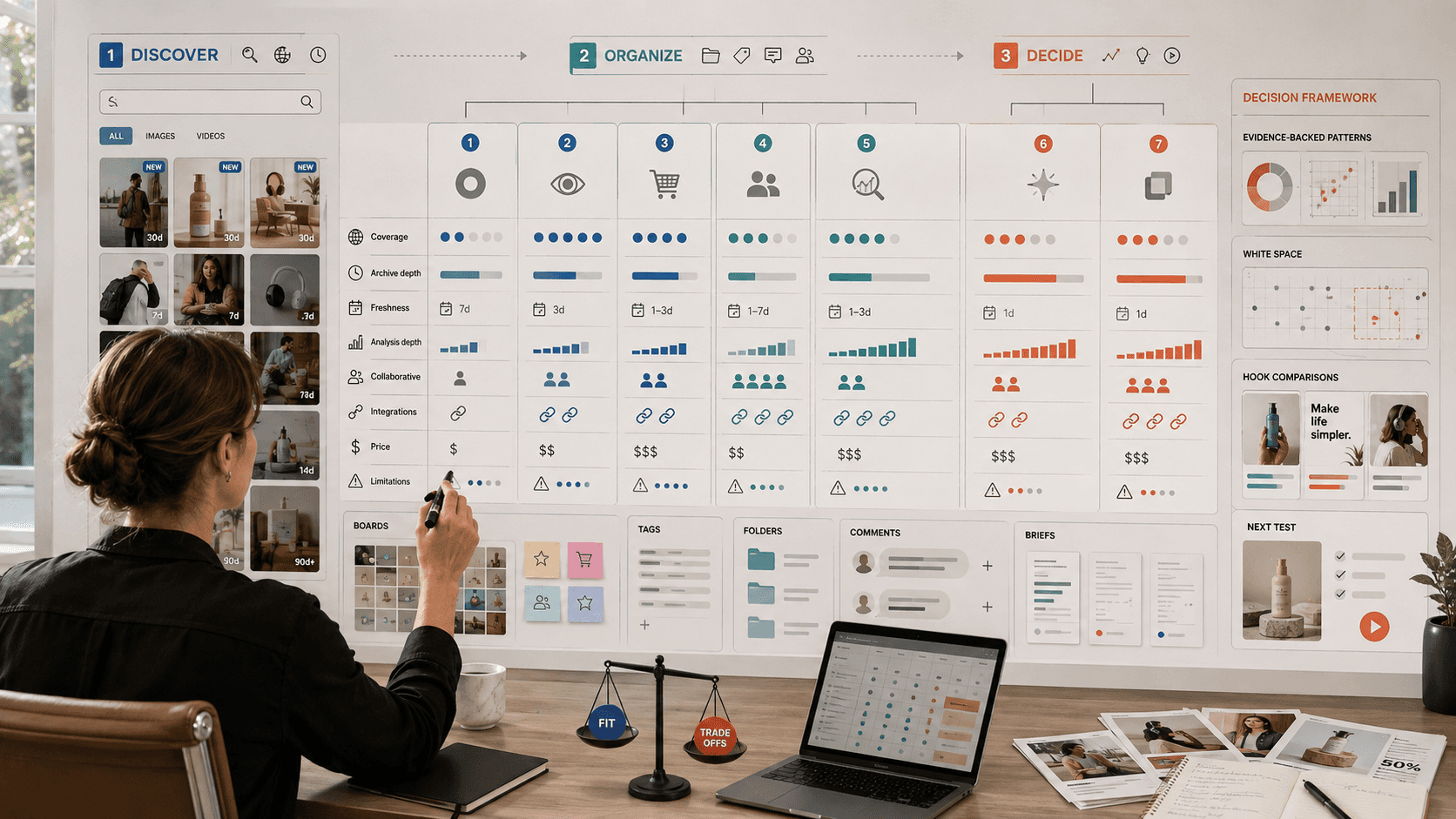
Best Ad Intelligence Tools in 2026: An Honest Breakdown
Best Ad Intelligence Tools in 2026: An Honest Breakdown
The market
The market
is moving right now.
is moving right now.
Your competitors' intelligence is updating. Your next brief will either start from what's actually working in your category this week, or it won't.
Your competitors' intelligence is updating. Your next brief will either start from what's actually working in your category this week, or it won't.
Free signup
Free signup
Pay as you go
Pay as you go
Cancel whenever
Cancel whenever
ADOLOGY AI
ADOLOGY AI
Marketing intelligence that holds itself accountable. Watches your market continuously, ships intelligence into your workflows, grades itself on every call.
Marketing intelligence that holds itself accountable. Watches your market continuously, ships intelligence into your workflows, grades itself on every call.
ADOLOGY
© 2026 Adology. All rights reserved.
© 2026 Adology. All rights reserved.