Back
Back
How to Run a Competitive Ad Audit in an Afternoon (7-Step Framework, 2026)
How to Run a Competitive Ad Audit in an Afternoon (7-Step Framework, 2026)

7steps, start to decision | 4competitors compared | 281posts read in one pass | 1afternoon, not aquarter |
7steps, start to decision | 4competitors compared | 281posts read in one pass | 1afternoon, not aquarter |
Key takeaways
Key takeaways
A competitive ad audit is a fixed-window read of one brand against three or four rivals. You score four things: posting volume, engagement, top-post hooks, and community gaps. Then you end with one decision.
You can run it in an afternoon because you're reading patterns, not archiving every post. The seven steps below are the whole process.
Rank competitors by engagement, rather than post count. The brand that posts most often is rarely the one winning attention.
The audit is only worth doing if it changes what you do next. If it ends in a folder of screenshots, you've researched, not audited.
A competitive ad audit is a fixed-window read of one brand against three or four rivals. You score four things: posting volume, engagement, top-post hooks, and community gaps. Then you end with one decision.
You can run it in an afternoon because you're reading patterns, not archiving every post. The seven steps below are the whole process.
Rank competitors by engagement, rather than post count. The brand that posts most often is rarely the one winning attention.
The audit is only worth doing if it changes what you do next. If it ends in a folder of screenshots, you've researched, not audited.
A competitive ad audit, in seven steps
A competitive ad audit, in seven steps
Run it in seven steps: pick a focal brand and three competitors, lock one window, then measure posting volume, engagement, top-post hooks, and community gaps, and finish on one decision.
Most teams know the old, time-consuming version, the one that eats a week. A client asks what the competition is up to. Someone starts scrolling through feeds and pasting screenshots into a deck. Three days later, it lands on the call already stale, and everyone nods and moves on.
The version below takes an afternoon, and it ends with a decision you can use. You only look at the handful of things that change what you post next.
The worked example below audits Tecovas, a direct-to-consumer western boot brand, against Ariat, Lucchese, and Justin Boots, across February and March 2026. Every figure is a real-time analysis from that set. Swap in your own brands, and the process is identical.
The seven steps:
Choose the set: one focal brand, three or four direct competitors.
Lock one-time window.
Measure posting volume and cadence.
Rank by engagement, not volume.
Pull the top posts and decode the hook.
Read the community for gaps.
Turn the analysis into one actionable decision.
Step 1: Which brands should you include in a competitive ad audit?
Pick one focal brand and three to four direct competitors, no more. A tight set keeps the audit to an afternoon and keeps the comparison honest, because brands in the same category share the same buyers and seasons. A tenth competitor adds hours and rarely changes the decision.
In the worked example, the set is Tecovas against Ariat, Lucchese, and Justin Boots, who sell to overlapping buyers. Avoid brands that only look like competitors. A running-shoe giant is not a rival to a western boot brand, even if both sell footwear.
Step 2: What time window should a competitive ad audit cover?
Lock one fixed window before you pull anything, usually the last 30 or 90 days, and compare it to the window just before. That is what lets you say a number went up or down instead of guessing. The worked example uses March 2026 against February 2026.
Match the window to your cadence. A monthly window catches shifts in strategy and share of voice; a weekly window catches individual posts while they are still worth reacting to. Decide once, then hold it for every brand so the comparison stays fair.
Step 3: How do you measure how often competitors post?
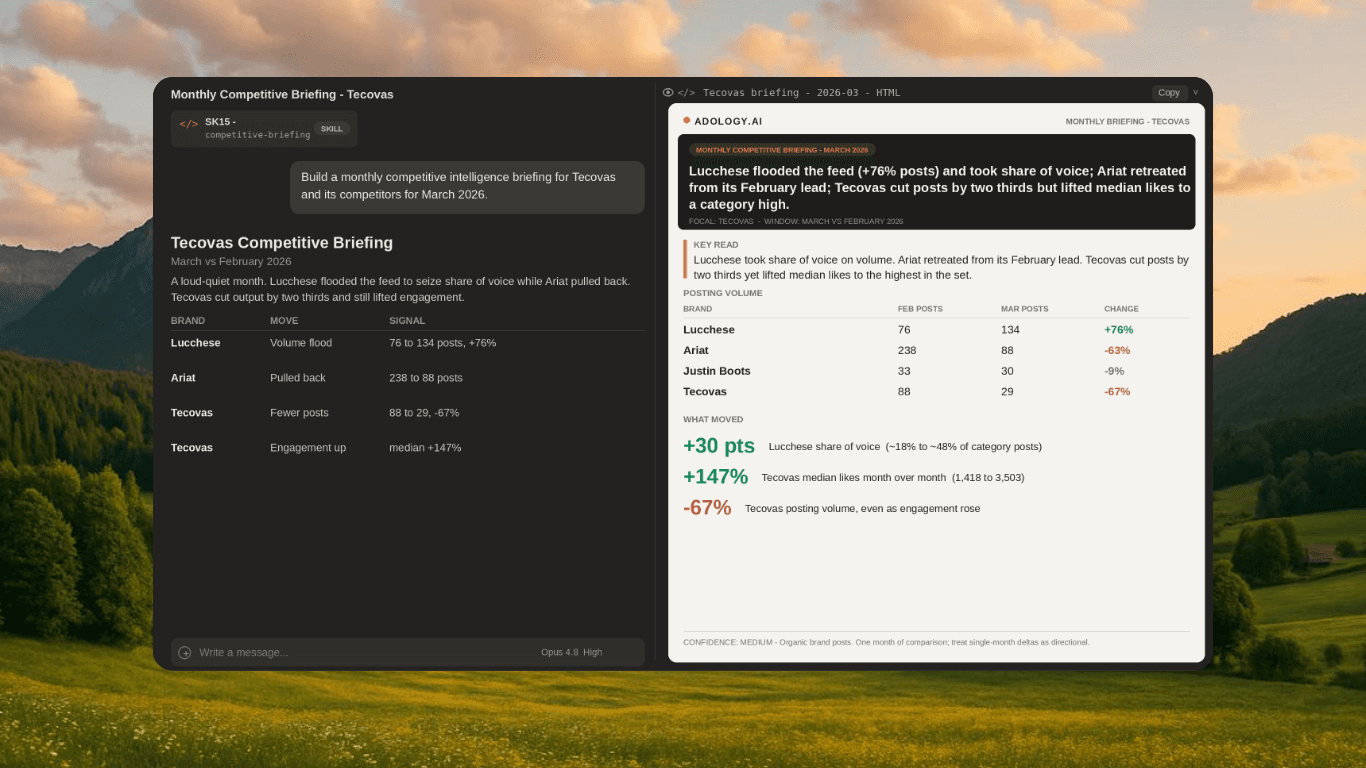
Count posts per brand inside your window, then compare each brand to its own prior window. Volume alone is not a verdict, but a sharp swing is worth tracking. In the worked example, Lucchese flooded the feed with 134 posts in March, up 76% from 76 in February, while Ariat pulled back from 238 to 88. Tecovas posted the fewest, 29, down from 88.
That spread is the first indicator: one brand is betting on volume, one is conserving, one is quiet. None of it tells you who won yet, which is the next step.
Step 4: How do you tell which competitor's ads are actually working?
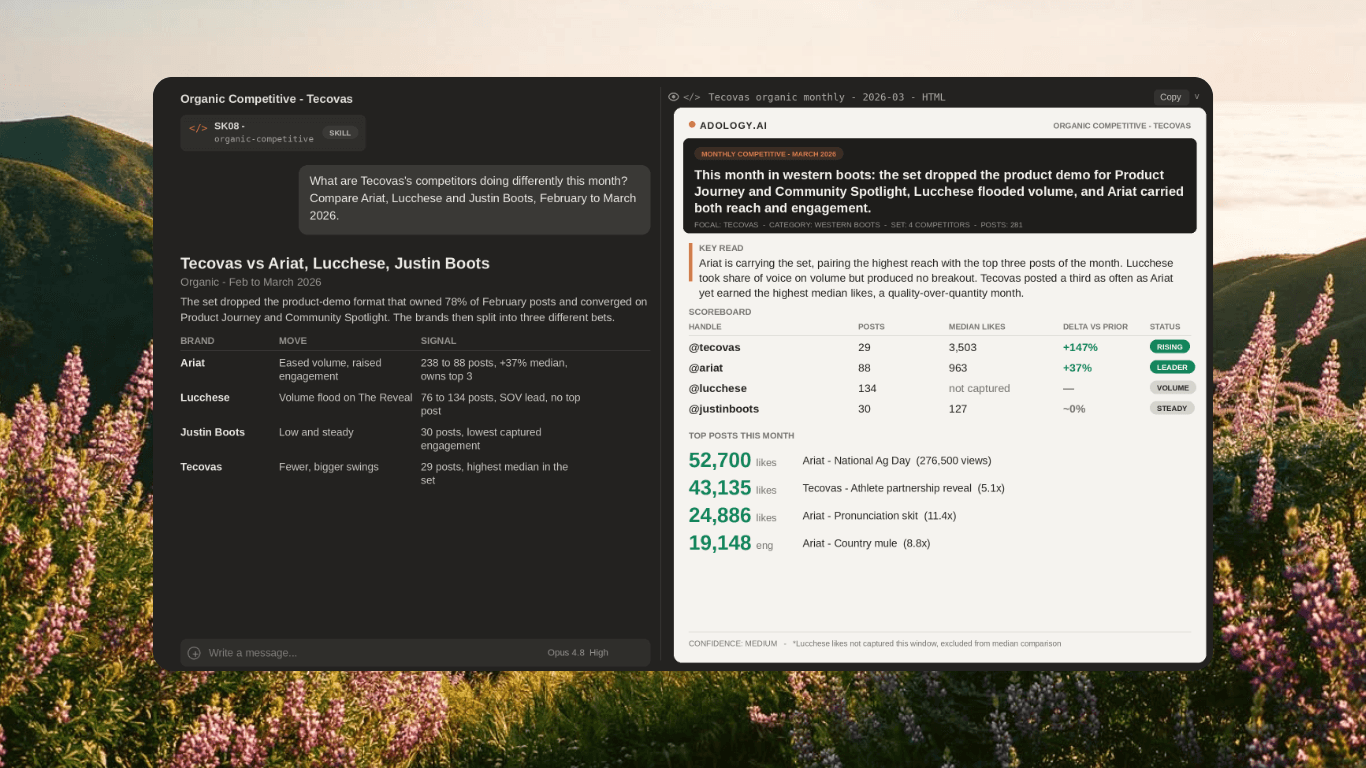
Rank the brands by engagement. Use median likes per post, which is harder to skew than the average, and read it alongside volume. In the worked example, Tecovas posted the fewest but had the highest median likes at 3,503, up 147% month over month. Ariat sat at 963, Justin Boots at 127, and Lucchese's flood of posts did not lead to engagement.
The loudest brand in a category is rarely the one earning the most attention per post.
Quick note: Lucchese's per-post likes didn't come through this window, so it stays out of the engagement ranking rather than showing up as a misleading zero.
Step 5: How do you find and decode a competitor's best posts?
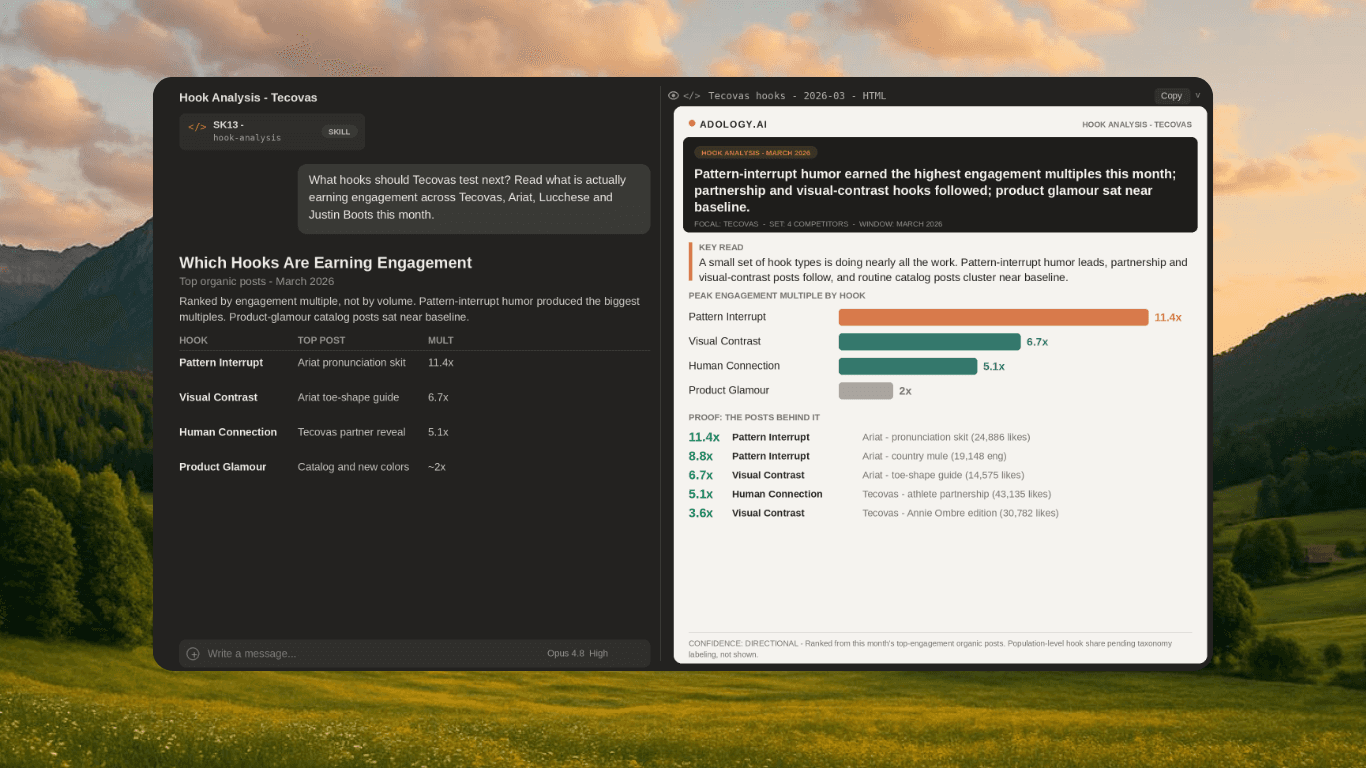
Pull each brand's top posts by engagement and read the hook, the opener that earns the stop. A single "like" count means little until you compare it to that brand's own baseline, which is the engagement multiple. In the worked example, the standouts were an Ariat National Ag Day tribute at 52,700 likes, a Tecovas athlete partnership at 43,135 likes and 5.1x baseline, an Ariat pronunciation skit at 24,886 likes and 11.4x, and an Ariat product reveal at 8.8x.
Those four say one thing: cultural moments, partnerships, and pattern-interrupt humor are carrying the category, while everyday catalog posts sit near baseline.
Step 6: How do you find content gaps in community discussions?
Find the community where your buyers talk, not just the brand feeds, because feeds show what brands want to say, and communities show what buyers actually ask and think. Pull the most active threads in your category's forums and tag the questions that keep coming up. In the worked example, the western boot conversation lives in Reddit r/cowboyboots, with more than 9,500 indexed discussions.
The recurring questions are a content goldmine for brands. If buyers keep asking how to spot good leather or which brands to trust, the brand that answers well becomes useful to the exact people it wants.
This step also shows whether your brand is even present where the category is discussed, a gap nobody usually notices.
Step 7: How do you turn a competitive ad audit into one decision?
Distill the audit into one action item rather than a detailed summary. Spot the single highest-value activity the analysis supports. In the worked example, the decision is a reallocation: move calendar slots toward the concepts already running at 5x to 11x baseline, partnerships and pattern-interrupt humor, and away from catalog posts near 1x.
A simple way to sort it is Scale, Test, Cut. Scale what is already winning, test one new content asset per cycle, and cut the near-baseline filler. Then re-run the audit next window to see whether the move worked, because what wins shifts as creative fatigues. In one analysis, people who saw an ad 6 to 10 times were about 4% less likely to buy than those who saw it 2 to 5 times (Simulmedia, via RevenueCat, 2025).
A folder of screenshots is not an audit. The afternoon only pays off if it ends in one move you can make this week.
Run it in seven steps: pick a focal brand and three competitors, lock one window, then measure posting volume, engagement, top-post hooks, and community gaps, and finish on one decision.
Most teams know the old, time-consuming version, the one that eats a week. A client asks what the competition is up to. Someone starts scrolling through feeds and pasting screenshots into a deck. Three days later, it lands on the call already stale, and everyone nods and moves on.
The version below takes an afternoon, and it ends with a decision you can use. You only look at the handful of things that change what you post next.
The worked example below audits Tecovas, a direct-to-consumer western boot brand, against Ariat, Lucchese, and Justin Boots, across February and March 2026. Every figure is a real-time analysis from that set. Swap in your own brands, and the process is identical.
The seven steps:
Choose the set: one focal brand, three or four direct competitors.
Lock one-time window.
Measure posting volume and cadence.
Rank by engagement, not volume.
Pull the top posts and decode the hook.
Read the community for gaps.
Turn the analysis into one actionable decision.
Step 1: Which brands should you include in a competitive ad audit?
Pick one focal brand and three to four direct competitors, no more. A tight set keeps the audit to an afternoon and keeps the comparison honest, because brands in the same category share the same buyers and seasons. A tenth competitor adds hours and rarely changes the decision.
In the worked example, the set is Tecovas against Ariat, Lucchese, and Justin Boots, who sell to overlapping buyers. Avoid brands that only look like competitors. A running-shoe giant is not a rival to a western boot brand, even if both sell footwear.
Step 2: What time window should a competitive ad audit cover?
Lock one fixed window before you pull anything, usually the last 30 or 90 days, and compare it to the window just before. That is what lets you say a number went up or down instead of guessing. The worked example uses March 2026 against February 2026.
Match the window to your cadence. A monthly window catches shifts in strategy and share of voice; a weekly window catches individual posts while they are still worth reacting to. Decide once, then hold it for every brand so the comparison stays fair.
Step 3: How do you measure how often competitors post?
Count posts per brand inside your window, then compare each brand to its own prior window. Volume alone is not a verdict, but a sharp swing is worth tracking. In the worked example, Lucchese flooded the feed with 134 posts in March, up 76% from 76 in February, while Ariat pulled back from 238 to 88. Tecovas posted the fewest, 29, down from 88.
That spread is the first indicator: one brand is betting on volume, one is conserving, one is quiet. None of it tells you who won yet, which is the next step.
Step 4: How do you tell which competitor's ads are actually working?
Rank the brands by engagement. Use median likes per post, which is harder to skew than the average, and read it alongside volume. In the worked example, Tecovas posted the fewest but had the highest median likes at 3,503, up 147% month over month. Ariat sat at 963, Justin Boots at 127, and Lucchese's flood of posts did not lead to engagement.
The loudest brand in a category is rarely the one earning the most attention per post.
Quick note: Lucchese's per-post likes didn't come through this window, so it stays out of the engagement ranking rather than showing up as a misleading zero.
Step 5: How do you find and decode a competitor's best posts?
Pull each brand's top posts by engagement and read the hook, the opener that earns the stop. A single "like" count means little until you compare it to that brand's own baseline, which is the engagement multiple. In the worked example, the standouts were an Ariat National Ag Day tribute at 52,700 likes, a Tecovas athlete partnership at 43,135 likes and 5.1x baseline, an Ariat pronunciation skit at 24,886 likes and 11.4x, and an Ariat product reveal at 8.8x.
Those four say one thing: cultural moments, partnerships, and pattern-interrupt humor are carrying the category, while everyday catalog posts sit near baseline.
Step 6: How do you find content gaps in community discussions?
Find the community where your buyers talk, not just the brand feeds, because feeds show what brands want to say, and communities show what buyers actually ask and think. Pull the most active threads in your category's forums and tag the questions that keep coming up. In the worked example, the western boot conversation lives in Reddit r/cowboyboots, with more than 9,500 indexed discussions.
The recurring questions are a content goldmine for brands. If buyers keep asking how to spot good leather or which brands to trust, the brand that answers well becomes useful to the exact people it wants.
This step also shows whether your brand is even present where the category is discussed, a gap nobody usually notices.
Step 7: How do you turn a competitive ad audit into one decision?
Distill the audit into one action item rather than a detailed summary. Spot the single highest-value activity the analysis supports. In the worked example, the decision is a reallocation: move calendar slots toward the concepts already running at 5x to 11x baseline, partnerships and pattern-interrupt humor, and away from catalog posts near 1x.
A simple way to sort it is Scale, Test, Cut. Scale what is already winning, test one new content asset per cycle, and cut the near-baseline filler. Then re-run the audit next window to see whether the move worked, because what wins shifts as creative fatigues. In one analysis, people who saw an ad 6 to 10 times were about 4% less likely to buy than those who saw it 2 to 5 times (Simulmedia, via RevenueCat, 2025).
A folder of screenshots is not an audit. The afternoon only pays off if it ends in one move you can make this week.
Frequently asked questions
Frequently asked questions
How long does a competitive ad audit take?
An afternoon, once you focus on one focal brand, three or four competitors, and a single time window. The work that used to take a quarter was mostly collecting and sorting posts. When the analysis focuses on patterns rather than a complete archive, the audit fits within a few focused hours.
How many competitors should you include?
Three or four direct competitors, plus your focal brand. Fewer than three, and you have no category pattern; more than four, and the audit balloons without changing the decision. Choose brands that share your buyers, not just your product category.
What should a competitive ad audit measure?
A competitive ad audit measures four things across a fixed window: how much each brand posts, how much engagement each earns per post, which specific posts win, what hooks drive them, and what the audience is asking for in community discussion. The read then ends in one decision about what to do next.
What is an engagement multiple?
An engagement multiple compares a single post to its own brand's typical performance, so a post at 8.8x earned almost nine times that brand's baseline. It matters because it separates a real breakout from a post that only looks big. After all, the brand already has a large following.
How often should you run a competitive ad audit?
Run a light audit monthly and a deeper one each quarter. Monthly catches shift in volume, hooks, and share of voice while they are still actionable. A quarterly pass catches slower moves in positioning and narrative. Because ad performance decays with repetition, a one-time audit goes stale fast.
Do you need a tool to run a competitive ad audit?
The manual version works for a while: pick the set, fix the window, count volume, rank engagement, decode hooks, read the community, and decide. It starts to break when the market moves faster than you can collect, classify, and turn posts into a decision, which is the point where a tool like Adology earns its place.
How long does a competitive ad audit take?
An afternoon, once you focus on one focal brand, three or four competitors, and a single time window. The work that used to take a quarter was mostly collecting and sorting posts. When the analysis focuses on patterns rather than a complete archive, the audit fits within a few focused hours.
How many competitors should you include?
Three or four direct competitors, plus your focal brand. Fewer than three, and you have no category pattern; more than four, and the audit balloons without changing the decision. Choose brands that share your buyers, not just your product category.
What should a competitive ad audit measure?
A competitive ad audit measures four things across a fixed window: how much each brand posts, how much engagement each earns per post, which specific posts win, what hooks drive them, and what the audience is asking for in community discussion. The read then ends in one decision about what to do next.
What is an engagement multiple?
An engagement multiple compares a single post to its own brand's typical performance, so a post at 8.8x earned almost nine times that brand's baseline. It matters because it separates a real breakout from a post that only looks big. After all, the brand already has a large following.
How often should you run a competitive ad audit?
Run a light audit monthly and a deeper one each quarter. Monthly catches shift in volume, hooks, and share of voice while they are still actionable. A quarterly pass catches slower moves in positioning and narrative. Because ad performance decays with repetition, a one-time audit goes stale fast.
Do you need a tool to run a competitive ad audit?
The manual version works for a while: pick the set, fix the window, count volume, rank engagement, decode hooks, read the community, and decide. It starts to break when the market moves faster than you can collect, classify, and turn posts into a decision, which is the point where a tool like Adology earns its place.
Run your first audit on your category
Run your first audit on your category
The manual version holds right up until collecting and sorting the posts is the part eating your afternoon. That is where this gets handed off. Send your focal brand and three or four competitors, and Adology runs the first pass, every step above, so the finished read lands on your desk instead of staying on your to do list.
Book the first pass.
The manual version holds right up until collecting and sorting the posts is the part eating your afternoon. That is where this gets handed off. Send your focal brand and three or four competitors, and Adology runs the first pass, every step above, so the finished read lands on your desk instead of staying on your to do list.
Book the first pass.

How to Analyze What Social Listening Misses in Video Posts
How to Analyze What Social Listening Misses in Video Posts

How to Build a Competitive Creative Briefing Executives Will Actually Use
How to Build a Competitive Creative Briefing Executives Will Actually Use

Your Swipe File Is Dysfunctional. Let’s Fix It
Your Swipe File Is Dysfunctional. Let’s Fix It

Why Better Prompts Don’t Fix Generic Marketing Advice
Why Better Prompts Don’t Fix Generic Marketing Advice

How to Benchmark Competitor Creative Against Client Goals
How to Benchmark Competitor Creative Against Client Goals

What Are Hydration Brands Actually Selling?
What Are Hydration Brands Actually Selling?

Is It a Creative Pattern or a Standout Ad?
Is It a Creative Pattern or a Standout Ad?

How to Find Creative Whitespace in Competitor Ads
How to Find Creative Whitespace in Competitor Ads

How to Analyze Competitor Ads With an AI Assistant
How to Analyze Competitor Ads With an AI Assistant
Best Ad Intelligence Tools in 2026: An Honest Breakdown
Best Ad Intelligence Tools in 2026: An Honest Breakdown
The market
The market
is moving right now.
is moving right now.
Your competitors' intelligence is updating. Your next brief will either start from what's actually working in your category this week, or it won't.
Your competitors' intelligence is updating. Your next brief will either start from what's actually working in your category this week, or it won't.
Free signup
Free signup
Pay as you go
Pay as you go
Cancel whenever
Cancel whenever
ADOLOGY AI
ADOLOGY AI
Marketing intelligence that holds itself accountable. Watches your market continuously, ships intelligence into your workflows, grades itself on every call.
Marketing intelligence that holds itself accountable. Watches your market continuously, ships intelligence into your workflows, grades itself on every call.
ADOLOGY
© 2026 Adology. All rights reserved.
© 2026 Adology. All rights reserved.