Back
Back
Best Ad Intelligence Tools in 2026: An Honest Breakdown
Best Ad Intelligence Tools in 2026: An Honest Breakdown
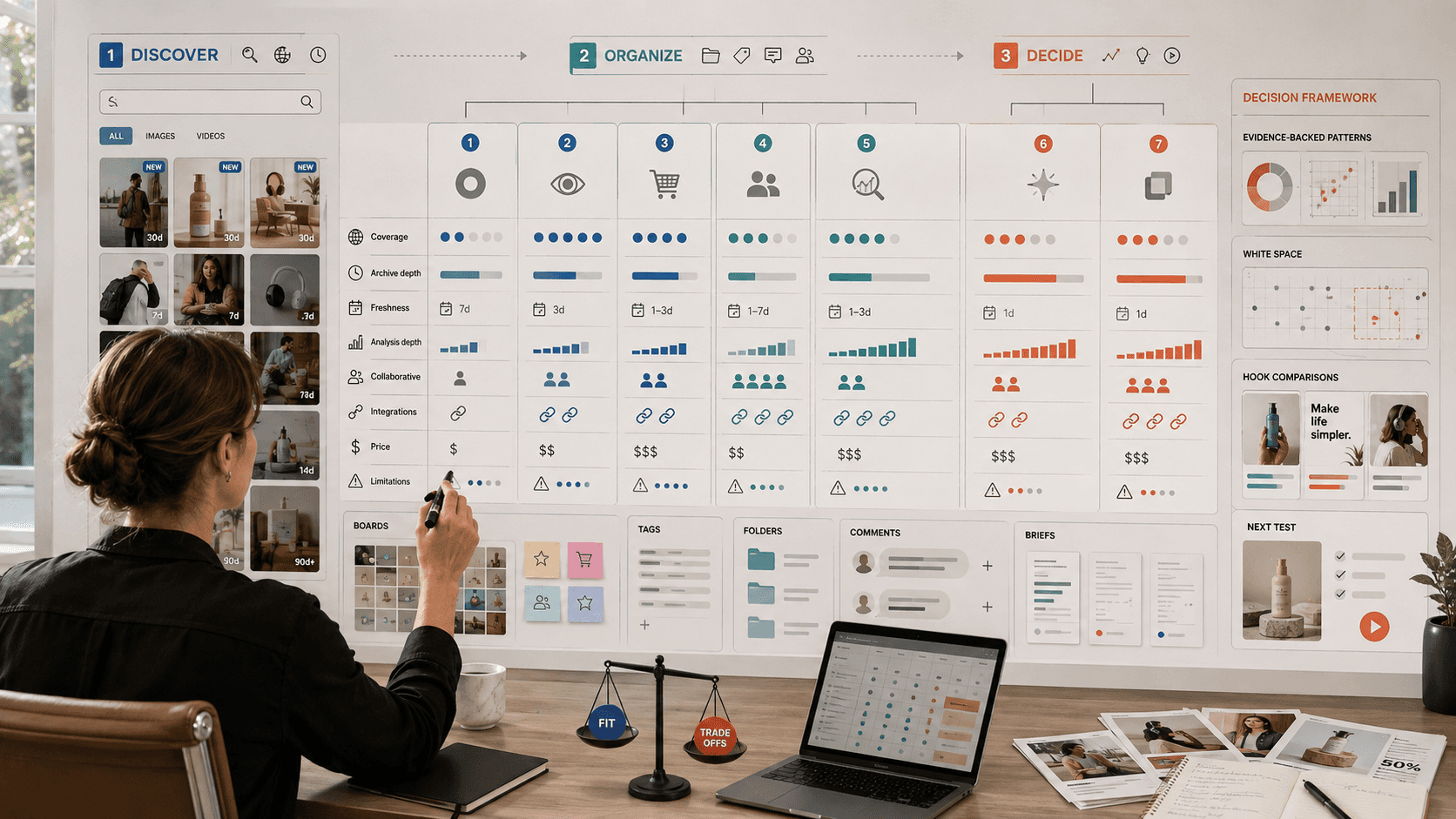
Table of Contents
Compare Meta Ad Library, AdSpy, BigSpy, Minea, Foreplay, Semrush, and Adology by the job each tool handles: finding ads, organizing research, or deciding what to make next.
Compare Meta Ad Library, AdSpy, BigSpy, Minea, Foreplay, Semrush, and Adology by the job each tool handles: finding ads, organizing research, or deciding what to make next.
Best ad intelligence tools in 2026: quick picks
Best ad intelligence tools in 2026: quick picks
Prices below are public self-serve prices shown on official vendor pages as of July 21, 2026. Temporary offers, taxes, add-ons, and enterprise contracts can change the total.
Tool | Best for | Entry price | Why it fits |
|---|---|---|---|
Meta Ad Library | Free active-ad discovery | $0 | The baseline for current ads across Meta products. Commercial ads do not expose targeting, budget, or spend. |
AdSpy | Large Facebook and Instagram archive | $149/mo | Fast, high-volume search. The analyst still has to interpret the ads and write the brief. |
BigSpy | Multi-platform ad search | Free; Pro $149/mo | A low-friction starting point with broad channel coverage. Check freshness in your target markets. |
Minea | E-commerce and product research | $49/mo | Connects ad research with products, shops, and brand tracking. Best suited to commerce workflows. |
Foreplay | Creative workflow and collaboration | $59/mo; $49/mo annual | Boards, briefs, tracking, analytics, API, and MCP. It now spans several jobs in the workflow. |
Semrush Advertising Toolkit | Paid search and cross-channel context | $99/mo annual | Strong PPC and competitor context. Some metrics are modeled benchmarks rather than account data. |
Adology | Category decisions and AI workflows | $49/mo Pro | Turns market signals into briefs, hook banks, claim reads, and other structured outputs through the app or MCP. |
Prices below are public self-serve prices shown on official vendor pages as of July 21, 2026. Temporary offers, taxes, add-ons, and enterprise contracts can change the total.
Tool | Best for | Entry price | Why it fits |
|---|---|---|---|
Meta Ad Library | Free active-ad discovery | $0 | The baseline for current ads across Meta products. Commercial ads do not expose targeting, budget, or spend. |
AdSpy | Large Facebook and Instagram archive | $149/mo | Fast, high-volume search. The analyst still has to interpret the ads and write the brief. |
BigSpy | Multi-platform ad search | Free; Pro $149/mo | A low-friction starting point with broad channel coverage. Check freshness in your target markets. |
Minea | E-commerce and product research | $49/mo | Connects ad research with products, shops, and brand tracking. Best suited to commerce workflows. |
Foreplay | Creative workflow and collaboration | $59/mo; $49/mo annual | Boards, briefs, tracking, analytics, API, and MCP. It now spans several jobs in the workflow. |
Semrush Advertising Toolkit | Paid search and cross-channel context | $99/mo annual | Strong PPC and competitor context. Some metrics are modeled benchmarks rather than account data. |
Adology | Category decisions and AI workflows | $49/mo Pro | Turns market signals into briefs, hook banks, claim reads, and other structured outputs through the app or MCP. |
The ad intelligence buying decision most teams get wrong
The ad intelligence buying decision most teams get wrong
Your team can collect thousands of competitor ads and still leave the review meeting without a brief. That happens when the tool solves retrieval while the team needs interpretation. The buying decision becomes easier once you separate the work into three jobs.
Most products sell one of two promises: more creatives to inspect, or a clearer recommendation. Between those promises sits the organization job, where teams save, tag, share, and brief from what they found. The workflow has three jobs even when the market presents two camps.
Your team can collect thousands of competitor ads and still leave the review meeting without a brief. That happens when the tool solves retrieval while the team needs interpretation. The buying decision becomes easier once you separate the work into three jobs.
Most products sell one of two promises: more creatives to inspect, or a clearer recommendation. Between those promises sits the organization job, where teams save, tag, share, and brief from what they found. The workflow has three jobs even when the market presents two camps.
What an ad intelligence tool does in 2026
What an ad intelligence tool does in 2026
An ad intelligence tool collects advertising activity and makes it easier to search, compare, or interpret. The simplest products show current ads. More advanced products add historical archives, multi-platform coverage, saved research, creative analysis, or structured recommendations.
The useful question is not which platform has the longest feature list. Ask which part of the workflow is slowing your team down today, then buy for that job.
An ad intelligence tool collects advertising activity and makes it easier to search, compare, or interpret. The simplest products show current ads. More advanced products add historical archives, multi-platform coverage, saved research, creative analysis, or structured recommendations.
The useful question is not which platform has the longest feature list. Ask which part of the workflow is slowing your team down today, then buy for that job.
How we evaluated the ad intelligence tools
How we evaluated the ad intelligence tools
METHOD We reviewed official vendor feature, help, and pricing pages on July 21, 2026. Each tool was assessed across coverage, search and history, organization, creative analysis, access and integrations, and public price. We did not run a controlled head-to-head performance test of every paid plan. Vendor-reported capabilities are treated as product claims, and prices exclude taxes, promotions, add-ons, and custom contracts. |
METHOD We reviewed official vendor feature, help, and pricing pages on July 21, 2026. Each tool was assessed across coverage, search and history, organization, creative analysis, access and integrations, and public price. We did not run a controlled head-to-head performance test of every paid plan. Vendor-reported capabilities are treated as product claims, and prices exclude taxes, promotions, add-ons, and custom contracts. |
The three jobs ad intelligence tools perform
The three jobs ad intelligence tools perform
Use these jobs as dominant use cases rather than rigid product categories. Several tools now cover more than one stage.
1 | Discovery. Answer: “What are competitors running?” Typical outputs include current ads, historical ads, filters, landing pages, and run-duration signals. You need another layer when people still spend hours tagging and summarizing what they found. |
2 | Organization. Answer: “How do we save, share, and brief from this research?” Typical outputs include boards, tags, transcripts, comments, and creative briefs. You need another layer when the library is clean but the team still cannot explain which patterns matter. |
3 | Decision. Answer: “What should we make next?” Typical outputs include scored hooks, claims, formats, white-space opportunities, and recommendations. This layer deserves the most scrutiny because the dataset, metric, and method determine whether the recommendation is useful. |
Use these jobs as dominant use cases rather than rigid product categories. Several tools now cover more than one stage.
1 | Discovery. Answer: “What are competitors running?” Typical outputs include current ads, historical ads, filters, landing pages, and run-duration signals. You need another layer when people still spend hours tagging and summarizing what they found. |
2 | Organization. Answer: “How do we save, share, and brief from this research?” Typical outputs include boards, tags, transcripts, comments, and creative briefs. You need another layer when the library is clean but the team still cannot explain which patterns matter. |
3 | Decision. Answer: “What should we make next?” Typical outputs include scored hooks, claims, formats, white-space opportunities, and recommendations. This layer deserves the most scrutiny because the dataset, metric, and method determine whether the recommendation is useful. |
The best ad intelligence tools in 2026, reviewed
The best ad intelligence tools in 2026, reviewed
1. Meta Ad Library
BEST FOR: FREE ACTIVE-AD DISCOVERY
Meta says the Ad Library lets anyone search ads that are currently running across Meta products. For standard commercial ads, the library does not expose targeting, budget, or spend details. It is a strong baseline for discovery. Performance scoring and broad commercial history still have to happen elsewhere.[1]
Choose it when: you need a free, current view of a competitor’s Meta ads.
Watch for: limited commercial history and no direct creative performance score.
2. AdSpy
BEST FOR: HIGH-VOLUME FACEBOOK AND INSTAGRAM SEARCH
AdSpy positions itself as a large, fast-searchable ad database and lists one public plan at $149 per month with virtually unlimited usage. It is useful when an analyst needs concentrated ad search and filtering without building a private archive. The platform still leaves interpretation and creative briefing to the team.[2]
Choose it when: your main need is deep paid discovery on Meta-family channels.
Watch for: a single public price tier and a workflow centered on discovery.
3. BigSpy
BEST FOR: MULTI-PLATFORM DISCOVERY WITH A FREE STARTING PLAN
BigSpy’s current site lists a free plan and a $149 per month Pro plan. The company advertises coverage across ten major channels. The free tier works for light research. Pro is a better fit when teams need regular multi-platform search and page tracking.[3]
Choose it when: you need broad channel coverage before committing to a paid plan.
Watch for: data freshness and coverage can vary by market, so test the brands and regions you care about.
4. Minea
BEST FOR: E-COMMERCE AND DROPSHIPPING PRODUCT RESEARCH
Minea’s Starter plan is listed at $49 per month. It combines Meta ad listings with product, shop, and brand-tracking workflows. The plan also includes limited AI ad analysis and transcription. This makes Minea useful when the research question connects an ad to a product or store.[4]
Choose it when: you run a commerce workflow and want ad, product, and shop research in one place.
Watch for: the product-research lens can be too narrow for B2B, institutional, or broad brand-strategy teams.
5. Foreplay
BEST FOR: CREATIVE WORKFLOW, COLLABORATION, AND PRODUCTION
Foreplay’s Basic plan is listed at $59 per month, or $49 per month on an annual plan. It includes Swipe File, Discovery, Briefs, Spyder, Lens, API access, and MCP. Foreplay now covers more than organization. Its strongest fit is a team that needs research to move into boards, briefs, tracking, and production without switching tools.[5]
Choose it when: your bottleneck is turning ad research into a repeatable creative workflow.
Watch for: evaluate whether its analytics answer your market-level decision questions or mainly support your internal creative process.
6. Semrush Advertising Toolkit
BEST FOR: PAID-SEARCH AND CROSS-CHANNEL CONTEXT
Semrush Advertising Research shows competitor paid-search keywords, ad copies, landing pages, and historical trends. The Advertising Toolkit Base plan is listed at $99 per month when billed annually. The $220 per month Pro plan adds AdClarity for display, video, and social competitor insights. Semrush explains that its paid-traffic metrics are modeled benchmarks and can differ from internal Google Ads data.[6]
Choose it when: paid search, landing pages, and broader advertising context matter as much as social creative.
Watch for: use modeled traffic and spend estimates as comparison signals, not as a replacement for first-party account data.
7. Adology
BEST FOR: CATEGORY DECISIONS AND AI-AGENT WORKFLOWS
Adology’s current site presents a full intelligence loop: study market signals, turn them into briefs and creative outputs, then grade recommendations against what shipped. The platform supports Claude and ChatGPT through MCP. Public pricing lists Pro at $49 per month and Business at $199 per month. It fits teams that already have ads to inspect and need category reads, hook banks, claim audits, creator vetting, or finished briefs.[7]
Choose it when: the team can find competitor content but still needs a structured answer and a clear next action.
Watch for: Adology publishes this guide. Test the output on your own category and review the scope, metric, and method before using a recommendation.
1. Meta Ad Library
BEST FOR: FREE ACTIVE-AD DISCOVERY
Meta says the Ad Library lets anyone search ads that are currently running across Meta products. For standard commercial ads, the library does not expose targeting, budget, or spend details. It is a strong baseline for discovery. Performance scoring and broad commercial history still have to happen elsewhere.[1]
Choose it when: you need a free, current view of a competitor’s Meta ads.
Watch for: limited commercial history and no direct creative performance score.
2. AdSpy
BEST FOR: HIGH-VOLUME FACEBOOK AND INSTAGRAM SEARCH
AdSpy positions itself as a large, fast-searchable ad database and lists one public plan at $149 per month with virtually unlimited usage. It is useful when an analyst needs concentrated ad search and filtering without building a private archive. The platform still leaves interpretation and creative briefing to the team.[2]
Choose it when: your main need is deep paid discovery on Meta-family channels.
Watch for: a single public price tier and a workflow centered on discovery.
3. BigSpy
BEST FOR: MULTI-PLATFORM DISCOVERY WITH A FREE STARTING PLAN
BigSpy’s current site lists a free plan and a $149 per month Pro plan. The company advertises coverage across ten major channels. The free tier works for light research. Pro is a better fit when teams need regular multi-platform search and page tracking.[3]
Choose it when: you need broad channel coverage before committing to a paid plan.
Watch for: data freshness and coverage can vary by market, so test the brands and regions you care about.
4. Minea
BEST FOR: E-COMMERCE AND DROPSHIPPING PRODUCT RESEARCH
Minea’s Starter plan is listed at $49 per month. It combines Meta ad listings with product, shop, and brand-tracking workflows. The plan also includes limited AI ad analysis and transcription. This makes Minea useful when the research question connects an ad to a product or store.[4]
Choose it when: you run a commerce workflow and want ad, product, and shop research in one place.
Watch for: the product-research lens can be too narrow for B2B, institutional, or broad brand-strategy teams.
5. Foreplay
BEST FOR: CREATIVE WORKFLOW, COLLABORATION, AND PRODUCTION
Foreplay’s Basic plan is listed at $59 per month, or $49 per month on an annual plan. It includes Swipe File, Discovery, Briefs, Spyder, Lens, API access, and MCP. Foreplay now covers more than organization. Its strongest fit is a team that needs research to move into boards, briefs, tracking, and production without switching tools.[5]
Choose it when: your bottleneck is turning ad research into a repeatable creative workflow.
Watch for: evaluate whether its analytics answer your market-level decision questions or mainly support your internal creative process.
6. Semrush Advertising Toolkit
BEST FOR: PAID-SEARCH AND CROSS-CHANNEL CONTEXT
Semrush Advertising Research shows competitor paid-search keywords, ad copies, landing pages, and historical trends. The Advertising Toolkit Base plan is listed at $99 per month when billed annually. The $220 per month Pro plan adds AdClarity for display, video, and social competitor insights. Semrush explains that its paid-traffic metrics are modeled benchmarks and can differ from internal Google Ads data.[6]
Choose it when: paid search, landing pages, and broader advertising context matter as much as social creative.
Watch for: use modeled traffic and spend estimates as comparison signals, not as a replacement for first-party account data.
7. Adology
BEST FOR: CATEGORY DECISIONS AND AI-AGENT WORKFLOWS
Adology’s current site presents a full intelligence loop: study market signals, turn them into briefs and creative outputs, then grade recommendations against what shipped. The platform supports Claude and ChatGPT through MCP. Public pricing lists Pro at $49 per month and Business at $199 per month. It fits teams that already have ads to inspect and need category reads, hook banks, claim audits, creator vetting, or finished briefs.[7]
Choose it when: the team can find competitor content but still needs a structured answer and a clear next action.
Watch for: Adology publishes this guide. Test the output on your own category and review the scope, metric, and method before using a recommendation.
What a decision-tier ad intelligence output should include
What a decision-tier ad intelligence output should include
A decision-tier read should make its evidence visible. The reader needs to know what was analyzed, how performance was defined, which pattern appeared, what action follows, and what the result cannot prove.
Scope: brands, platforms, markets, and date range.
Sample: number of ads or posts and any inclusion rules.
Metric: engagement, spend signal, run duration, conversion data, or another stated measure.
Finding: the market pattern and the evidence behind it.
Decision: one specific change for the next brief or test.
Limitations: what is correlational, estimated, incomplete, or outside the dataset.
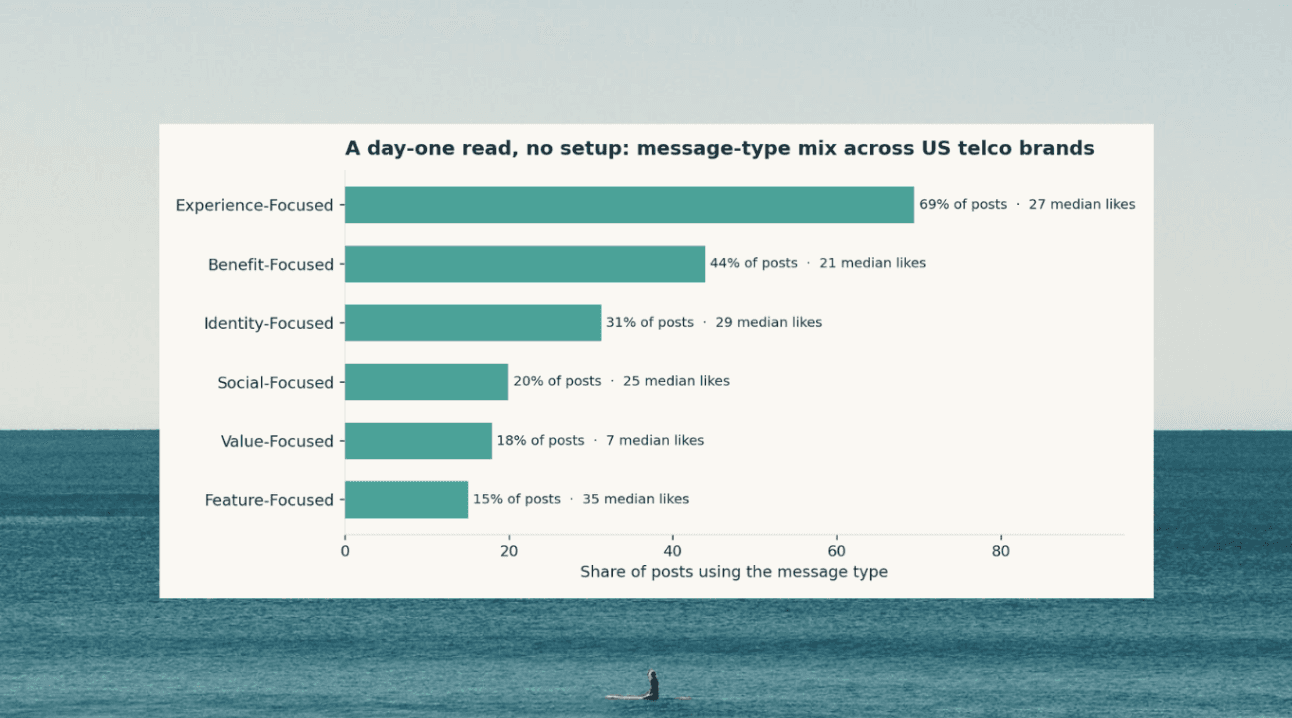
Example retained from the source draft: message-type prevalence and median engagement in a selected US telecom dataset.
Prompt example: Show the message-type mix across these brands, how often each type appears, its median engagement, and one implication for the next creative brief. |
EDITORIAL VERIFICATION REQUIRED Before publishing this chart as evidence, add the analyzed brands, date range, post count, platform mix, engagement definition, and confidence or inclusion rules. The chart describes associations within the selected dataset. It does not establish causation. |
A decision-tier read should make its evidence visible. The reader needs to know what was analyzed, how performance was defined, which pattern appeared, what action follows, and what the result cannot prove.
Scope: brands, platforms, markets, and date range.
Sample: number of ads or posts and any inclusion rules.
Metric: engagement, spend signal, run duration, conversion data, or another stated measure.
Finding: the market pattern and the evidence behind it.
Decision: one specific change for the next brief or test.
Limitations: what is correlational, estimated, incomplete, or outside the dataset.
Example retained from the source draft: message-type prevalence and median engagement in a selected US telecom dataset.
Prompt example: Show the message-type mix across these brands, how often each type appears, its median engagement, and one implication for the next creative brief. |
EDITORIAL VERIFICATION REQUIRED Before publishing this chart as evidence, add the analyzed brands, date range, post count, platform mix, engagement definition, and confidence or inclusion rules. The chart describes associations within the selected dataset. It does not establish causation. |
How to start without buying an ad intelligence tool
How to start without buying an ad intelligence tool
1 | Search three competitors. Use Meta Ad Library to review current ads across the same market and geography. |
2 | Tag the work consistently. Record the hook, format, claim, offer, audience, and start date in a simple document or spreadsheet. |
3 | Write one decision. At the end of the review, state what changed in the market and what your team will test next. Move to a paid tier when this process stops scaling. |
1 | Search three competitors. Use Meta Ad Library to review current ads across the same market and geography. |
2 | Tag the work consistently. Record the hook, format, claim, offer, audience, and start date in a simple document or spreadsheet. |
3 | Write one decision. At the end of the review, state what changed in the market and what your team will test next. Move to a paid tier when this process stops scaling. |
Disclosure and limits of this comparison
Disclosure and limits of this comparison
DISCLOSURE Adology publishes this guide and is one of the products included. That creates a commercial interest. Competing tool facts and prices were kept close to official vendor pages. Features and prices change, so recheck current terms before purchase. This is a workflow-based buyer’s guide, not a lab test of every plan. |
DISCLOSURE Adology publishes this guide and is one of the products included. That creates a commercial interest. Competing tool facts and prices were kept close to official vendor pages. Features and prices change, so recheck current terms before purchase. This is a workflow-based buyer’s guide, not a lab test of every plan. |
The takeaway: buy for the job your team is missing
The takeaway: buy for the job your team is missing
Discovery tools help you find ads. Organization tools keep the research usable. Decision tools connect the market read to the next brief. Teams waste money when they stack several subscriptions that solve the same first job.
Write down the question your CMO, strategist, or creative lead needs answered. Then choose the tool that produces that answer with the least manual work and the clearest evidence
Discovery tools help you find ads. Organization tools keep the research usable. Decision tools connect the market read to the next brief. Teams waste money when they stack several subscriptions that solve the same first job.
Write down the question your CMO, strategist, or creative lead needs answered. Then choose the tool that produces that answer with the least manual work and the clearest evidence
Try a decision-tier read on your category
Try a decision-tier read on your category
Point Adology at your brand and three competitors. Ask for the dominant hooks, underused claims, formats associated with stronger engagement, and one recommendation for the next brief. Adology can run through the app or through Claude and ChatGPT with MCP. The current explorer invite code is EXPLORE2026.
Point Adology at your brand and three competitors. Ask for the dominant hooks, underused claims, formats associated with stronger engagement, and one recommendation for the next brief. Adology can run through the app or through Claude and ChatGPT with MCP. The current explorer invite code is EXPLORE2026.
Frequently asked questions about ad intelligence tools
Frequently asked questions about ad intelligence tools
What is the best ad intelligence tool in 2026?
The best tool depends on the job. Meta Ad Library is the free discovery baseline. AdSpy and BigSpy add paid search and filtering. Minea is built around e-commerce research. Foreplay connects research to creative workflow. Semrush adds paid-search and cross-channel context. Adology focuses on structured category decisions and finished outputs.
Is Meta Ad Library enough for competitor research?
Meta Ad Library is enough when you only need to see current ads running across Meta products. It becomes limiting when you need deeper commercial history, cross-platform coverage, organization, performance signals, or a recommendation for the next brief.
What is the difference between an ad spy tool and an ad intelligence platform?
An ad spy tool makes competitor ads searchable. An ad intelligence platform adds analysis or decision support, such as scoring hooks, claims, formats, or market patterns. Many products now overlap, so compare the output you receive rather than relying only on the category label.
How much do ad intelligence tools cost in 2026?
The public self-serve plans in this guide range from free to $459 per month. Paid entry plans start at $49 per month for Minea and Adology, $59 per month for Foreplay on monthly billing, $99 per month for Semrush when billed annually, and $149 per month for AdSpy or BigSpy Pro. Enterprise contracts can be higher.
Can an AI agent analyze competitor ads?
Yes, when the platform exposes structured data through an API or MCP connection. Foreplay currently lists API and MCP access in its plans. Adology connects to Claude and ChatGPT through MCP and can return structured category reads, briefs, and other finished outputs.
What should I verify before trusting a creative recommendation?
Verify the brands, platforms, geography, date range, sample size, metric, and inclusion rules. Check whether the result is descriptive, correlational, or causal. A recommendation is more useful when the evidence and limitations are visible beside it.
What is the best ad intelligence tool in 2026?
The best tool depends on the job. Meta Ad Library is the free discovery baseline. AdSpy and BigSpy add paid search and filtering. Minea is built around e-commerce research. Foreplay connects research to creative workflow. Semrush adds paid-search and cross-channel context. Adology focuses on structured category decisions and finished outputs.
Is Meta Ad Library enough for competitor research?
Meta Ad Library is enough when you only need to see current ads running across Meta products. It becomes limiting when you need deeper commercial history, cross-platform coverage, organization, performance signals, or a recommendation for the next brief.
What is the difference between an ad spy tool and an ad intelligence platform?
An ad spy tool makes competitor ads searchable. An ad intelligence platform adds analysis or decision support, such as scoring hooks, claims, formats, or market patterns. Many products now overlap, so compare the output you receive rather than relying only on the category label.
How much do ad intelligence tools cost in 2026?
The public self-serve plans in this guide range from free to $459 per month. Paid entry plans start at $49 per month for Minea and Adology, $59 per month for Foreplay on monthly billing, $99 per month for Semrush when billed annually, and $149 per month for AdSpy or BigSpy Pro. Enterprise contracts can be higher.
Can an AI agent analyze competitor ads?
Yes, when the platform exposes structured data through an API or MCP connection. Foreplay currently lists API and MCP access in its plans. Adology connects to Claude and ChatGPT through MCP and can return structured category reads, briefs, and other finished outputs.
What should I verify before trusting a creative recommendation?
Verify the brands, platforms, geography, date range, sample size, metric, and inclusion rules. Check whether the result is descriptive, correlational, or causal. A recommendation is more useful when the evidence and limitations are visible beside it.

How to Analyze What Social Listening Misses in Video Posts
How to Analyze What Social Listening Misses in Video Posts

How to Build a Competitive Creative Briefing Executives Will Actually Use
How to Build a Competitive Creative Briefing Executives Will Actually Use

Your Swipe File Is Dysfunctional. Let’s Fix It
Your Swipe File Is Dysfunctional. Let’s Fix It

Why Better Prompts Don’t Fix Generic Marketing Advice
Why Better Prompts Don’t Fix Generic Marketing Advice

How to Benchmark Competitor Creative Against Client Goals
How to Benchmark Competitor Creative Against Client Goals

What Are Hydration Brands Actually Selling?
What Are Hydration Brands Actually Selling?

Is It a Creative Pattern or a Standout Ad?
Is It a Creative Pattern or a Standout Ad?

How to Find Creative Whitespace in Competitor Ads
How to Find Creative Whitespace in Competitor Ads

How to Analyze Competitor Ads With an AI Assistant
How to Analyze Competitor Ads With an AI Assistant

How to Analyze Competitor Ads (Without the Screenshot Grind)
How to Analyze Competitor Ads (Without the Screenshot Grind)
The market
The market
is moving right now.
is moving right now.
Your competitors' intelligence is updating. Your next brief will either start from what's actually working in your category this week, or it won't.
Your competitors' intelligence is updating. Your next brief will either start from what's actually working in your category this week, or it won't.
Free signup
Free signup
Pay as you go
Pay as you go
Cancel whenever
Cancel whenever
ADOLOGY AI
ADOLOGY AI
Marketing intelligence that holds itself accountable. Watches your market continuously, ships intelligence into your workflows, grades itself on every call.
Marketing intelligence that holds itself accountable. Watches your market continuously, ships intelligence into your workflows, grades itself on every call.
ADOLOGY
© 2026 Adology. All rights reserved.
© 2026 Adology. All rights reserved.