Back
Back
The Top 10 Use Case Examples of Adology MCP Marketing Intelligence
The Top 10 Use Case Examples of Adology MCP Marketing Intelligence

Direct answer Adology MCP connects an AI assistant to structured marketing intelligence and turns a question into a defined deliverable. In the supplied western-footwear test, one Knowledge Set produced ten outputs, including scorecards, competitive briefs, creator-verification reads, creative toolkits, hook test plans, and positioning memos. The strongest outputs also state what evidence supports the recommendation and where the data is incomplete. |
Direct answer Adology MCP connects an AI assistant to structured marketing intelligence and turns a question into a defined deliverable. In the supplied western-footwear test, one Knowledge Set produced ten outputs, including scorecards, competitive briefs, creator-verification reads, creative toolkits, hook test plans, and positioning memos. The strongest outputs also state what evidence supports the recommendation and where the data is incomplete. |
How the category stress test was structured
How the category stress test was structured
The article uses one defined market context rather than ten unrelated demos. Tecovas is the focal brand. Ariat, Lucchese, and Justin Boots form the competitor set. Community context comes from r/cowboyboots and r/Ranching. The published western-boot analysis covers organic brand posts from February and March 2026; narrower prompts use the windows stated in each example.
Focal brand | Tecovas |
Competitors | Ariat, Lucchese, and Justin Boots |
Community sources | r/cowboyboots and r/Ranching |
Published analysis window | February-March 2026 for the western-boot category analysis |
Data types | Organic brand content and public community content. The source set did not include paid-ad data. |
Observed signals | Post volume, public engagement, hook and format labels, creator activity, category conversation, and relative brand associations |
Known limitation | Some like counts were unavailable for part of the window. Scores, confidence rules, and several baselines still require linked product methodology before publication. |
The article uses one defined market context rather than ten unrelated demos. Tecovas is the focal brand. Ariat, Lucchese, and Justin Boots form the competitor set. Community context comes from r/cowboyboots and r/Ranching. The published western-boot analysis covers organic brand posts from February and March 2026; narrower prompts use the windows stated in each example.
Focal brand | Tecovas |
Competitors | Ariat, Lucchese, and Justin Boots |
Community sources | r/cowboyboots and r/Ranching |
Published analysis window | February-March 2026 for the western-boot category analysis |
Data types | Organic brand content and public community content. The source set did not include paid-ad data. |
Observed signals | Post volume, public engagement, hook and format labels, creator activity, category conversation, and relative brand associations |
Known limitation | Some like counts were unavailable for part of the window. Scores, confidence rules, and several baselines still require linked product methodology before publication. |
The Signal-to-Work Loop
The Signal-to-Work Loop
The framework has three steps. It reads the market, turns the finding into a usable deliverable, and makes the strength of the evidence visible before the team acts.
1 · STUDY Read competitors, creators, communities, hooks, formats, and brand movement. | 2 · PRODUCE Create a scorecard, brief, toolkit, test plan, or positioning memo. | 3 · VERIFY State the confidence level, missing data, and assumptions that still need testing. |
The framework has three steps. It reads the market, turns the finding into a usable deliverable, and makes the strength of the evidence visible before the team acts.
1 · STUDY Read competitors, creators, communities, hooks, formats, and brand movement. | 2 · PRODUCE Create a scorecard, brief, toolkit, test plan, or positioning memo. | 3 · VERIFY State the confidence level, missing data, and assumptions that still need testing. |
The 10 use cases at a glance
The 10 use cases at a glance
1. Brand health scoring
Is your brand's reputation actually improving, or just getting louder? A brand health scorecard tells you which. Reputation is a leading indicator. It moves weeks before sales or pipeline do, so a tracked score catches a slide early, while it's still cheap to fix. It also gives you a real number to bring to leadership when they ask whether the work is landing.
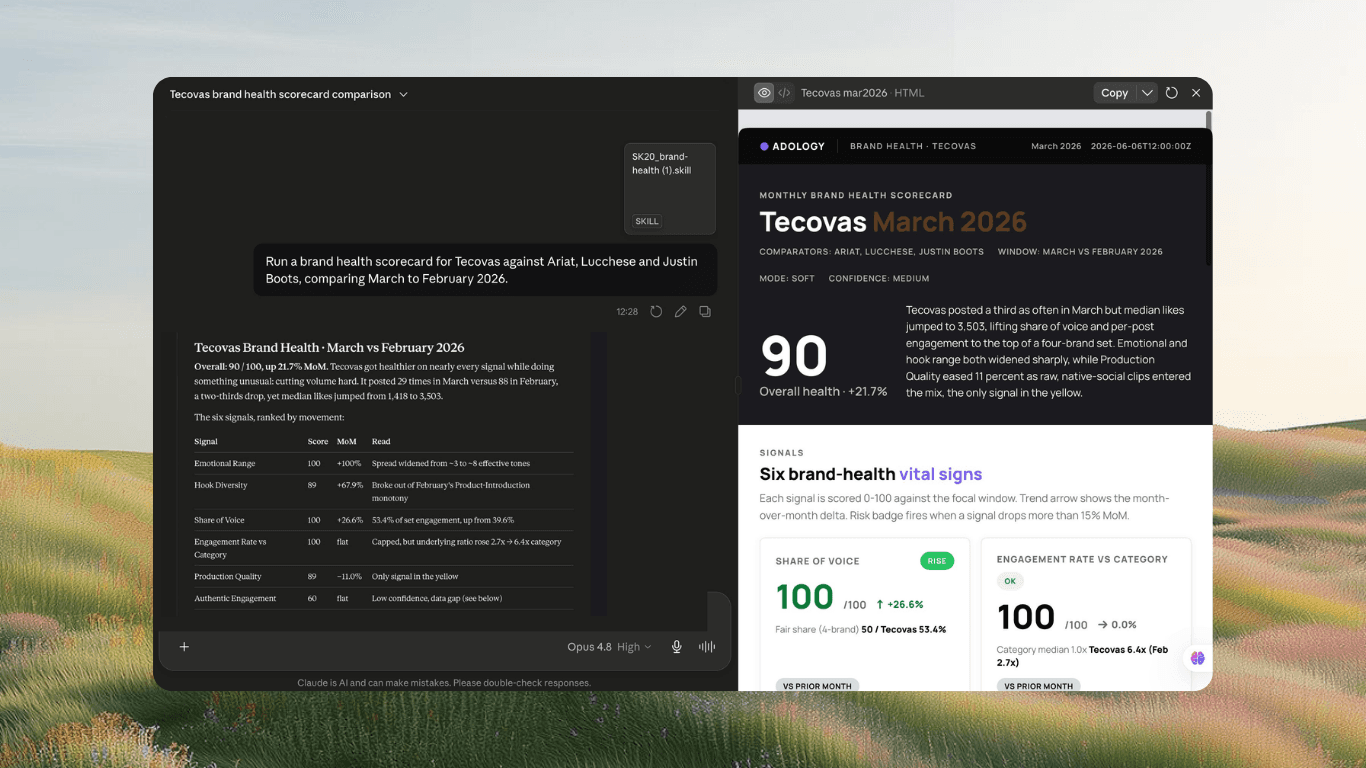
Adology MCP grades the brand and shows the inputs behind the grade. When something feels soft, you can see which driver actually dropped and spend against that instead of guessing. In one run, Tecovas scored 90 overall, up 21.7% month over month. The read came back MEDIUM confidence, because it only had one month to compare against the prior one.
A score like that only means something in context. Ninety against Ariat, Lucchese, and Justin Boots tells you whether you're leading the category or holding position. And the confidence flag does real work: it tells you how far to trust a single month before you reorganize a budget around it.
Prompt example: "Run a brand health scorecard for [your brand] against [competitor 1,2,3], comparing [month] to [month]."
2. Weekly competitive briefings
The Monday-morning read shouldn't be a screenshot folder. Right now, the competitive scan either doesn't happen, because nobody has a spare morning, or it lands as "here's what they posted" with no read on what to do. So you find out a rival's move worked once it's already everywhere, and you spend the quarter reacting to things you could have seen coming.
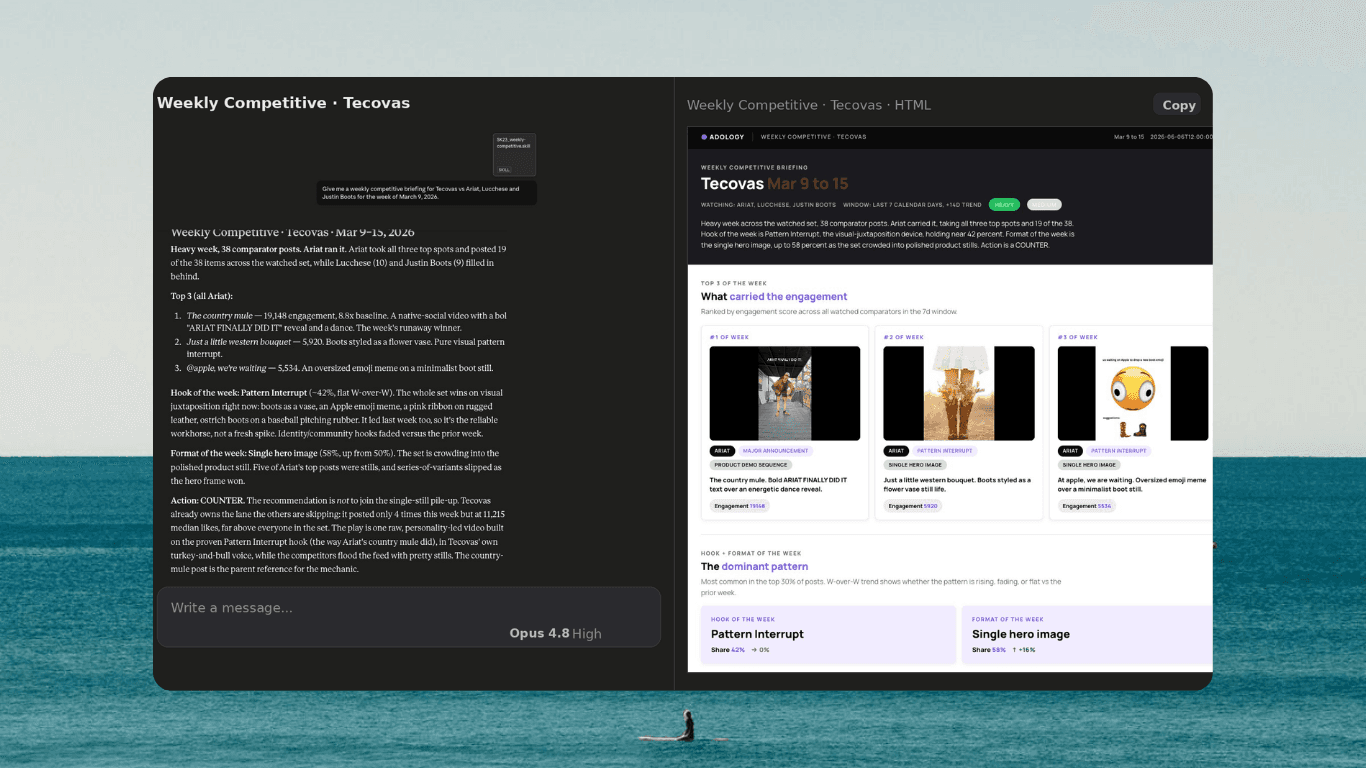
Adology MCP pulls the week's competitor activity, ranks what actually mattered, and tells you what to do about it. This run: Ariat owned 19 of the 38 posts in the set, and its country mule drop pulled 19,148 engagements at 8.8x its baseline on a Pattern Interrupt hook.
It didn't stop at "Ariat had a good week." It called for a counter-move. That means you start Monday with a decision instead of a research task, and when leadership asks what the competition is doing, you have a ranked answer and the receipts to back it. Plenty of dashboards tell you what happened last week. Far fewer hand you a move for Tuesday.
Prompt example: "Give me a weekly competitive briefing for [your brand] vs [competitor 1,2,3] for the week of [date]."
3. Monthly intelligence deep-dives
Sometimes the week is too small. A week shows you what your competitors posted. A month shows you what they're betting on: a hook strategy shifting, a narrative taking over, share of voice changing hands. None of that is visible in a seven-day window. It's also where you catch your own drift, the slow slide in output or reach that nobody notices from the inside until it gets counted.
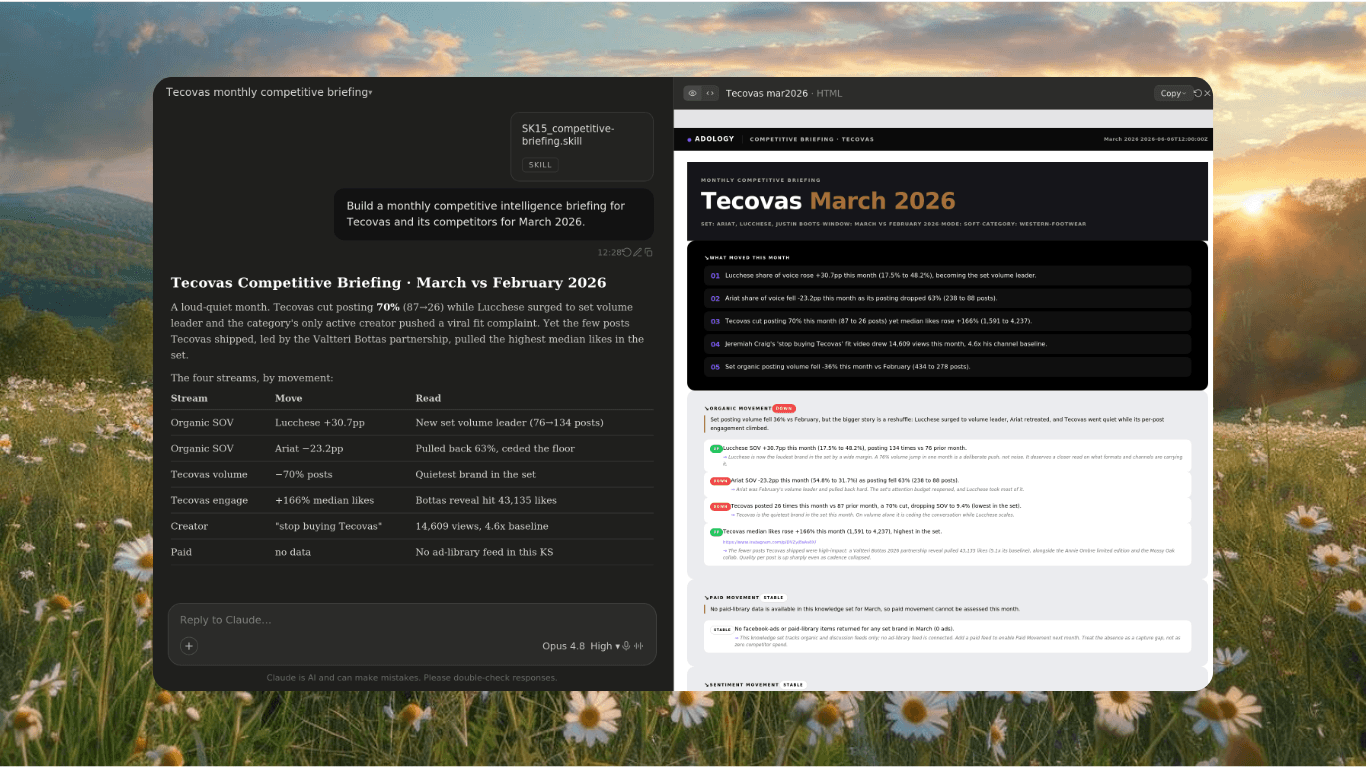
In this run, Lucchese's share of voice climbed 30.7 points on a "The Reveal" narrative. Ariat shifted toward Pattern Interrupt hooks. Tecovas went quiet: 29 posts, down from 88 the month before, which is exactly the kind of thing a brand rarely catches about itself.
The workflow also flagged what it couldn't analyze: there was no paid ad data in the set. Missing data gets called missing, not dressed up as insight, so you know where the read is solid and where it has a blind spot. And it lands on the cadence marketing actually runs on, so it slots into the monthly review and budget planning instead of becoming one more thing to pull together the night before.
Prompt example: "Build a monthly competitive intelligence briefing for [your brand] and its competitors for [month]."
4. Organic performance analysis
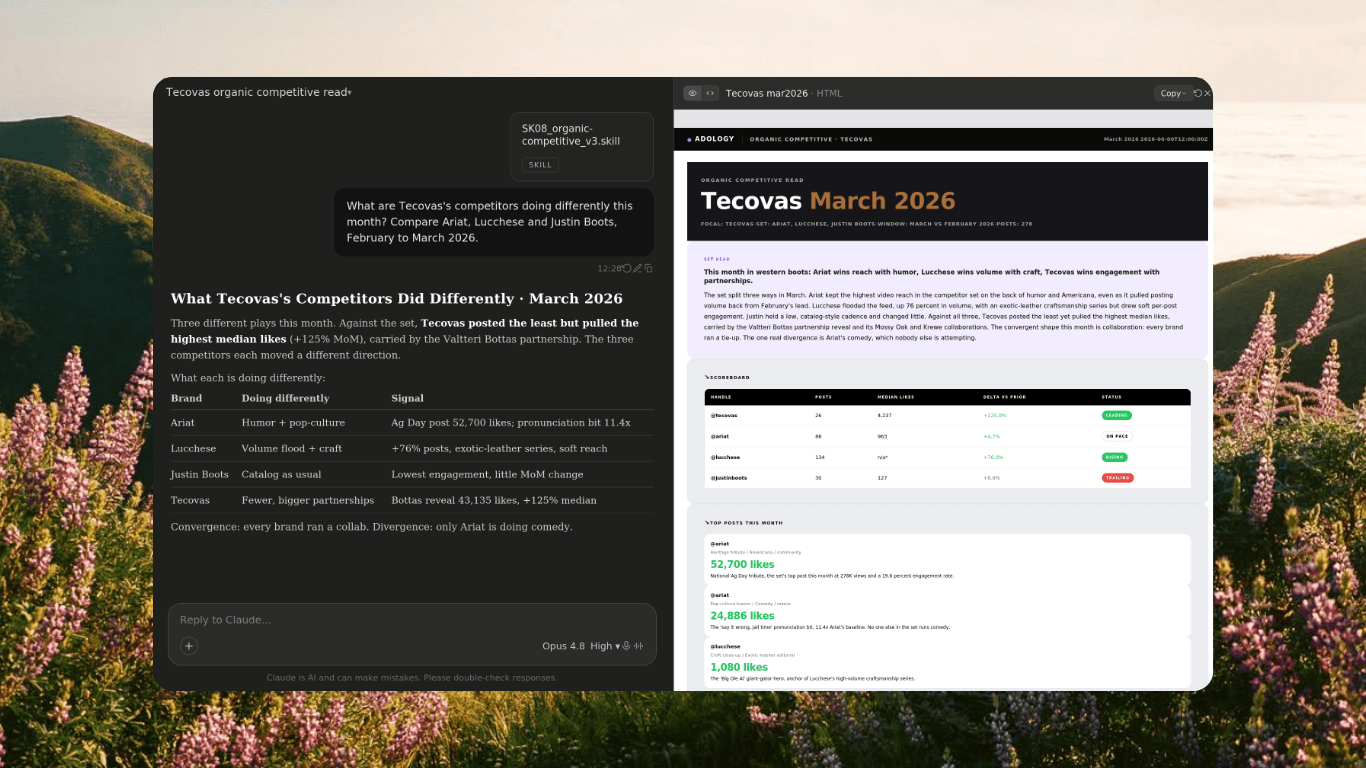
Paid data can hide a lot. Organic makes the category’s actual taste easier to see. In this run, the western boots set moved away from Demonstration content and converged on Product Journey and Community Spotlight formats. Ariat led on reach with an Ag Day post at 52,700. Tecovas posted the least, but held the highest median likes at 1,080.
The likes read was marked as "directional" because likes were not captured for part of the month. That is what a useful read should do: show the pattern, then tell the team how much confidence to put behind it.
Prompt example:
“What are [your brand's] competitors doing differently this month? Compare [competitors], [month to month].”
5. Influencer vetting
Creator fit shouldn't start and end with follower count. A big following tells you reach, not whether their audience is your audience, and it says nothing about the risks that sink a partnership after you've paid. A creator deal is slow and expensive to unwind. The valuable moment to catch a dealbreaker is before you sign.
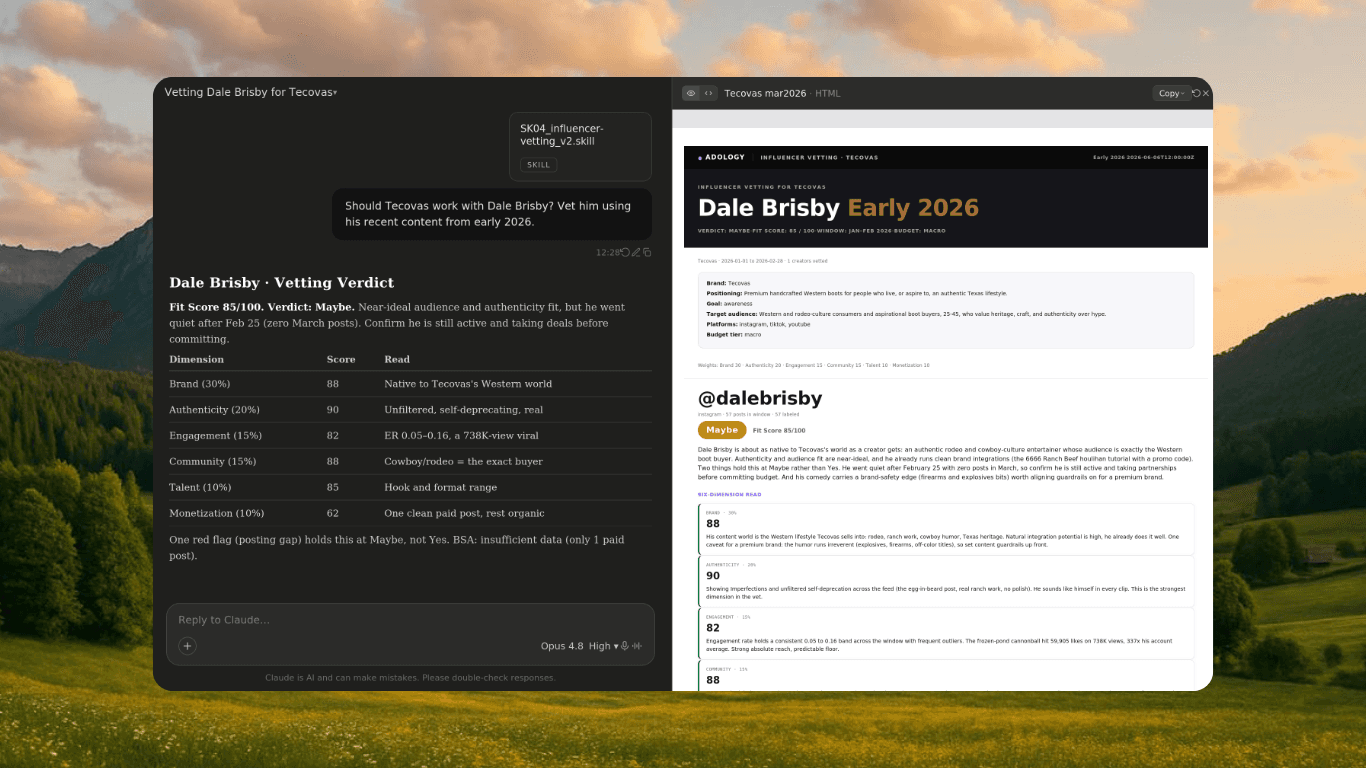
Ask Adology MCP to analyze a creator and a brand, and it returns a verdict with the reasoning attached. For Dale Brisby against Tecovas: a Fit Score of 85 and a verdict of Maybe. The content fit was strong, his Cowboy Culture and Rodeo Community audience mapping closely to the people Tecovas wants to reach, and one stunt post hit 59,905 likes, 337x his average.
The "Maybe" came from a single red flag: he posted 42 times in February, then went dark. That's the kind of thing a media kit won't tell you, and a quick scroll of his grid won't surface. So the recommendation wasn't "sign him." It was "confirm he's still active before committing," which is a call you can actually defend to whoever holds the budget.
Prompt example: "Should [your brand] work with [creator]? Vet [creator] using [his/her/their] recent content from [date/month/year]."
6. Community sentiment reads
Brand feeds show what brands want to say. Communities show what audiences actually care about. You can't see any of this from your own channels. The questions a community keeps asking tell you exactly what your content should cover. And the same read shows whether your brand is even present where your buyers spend their time.
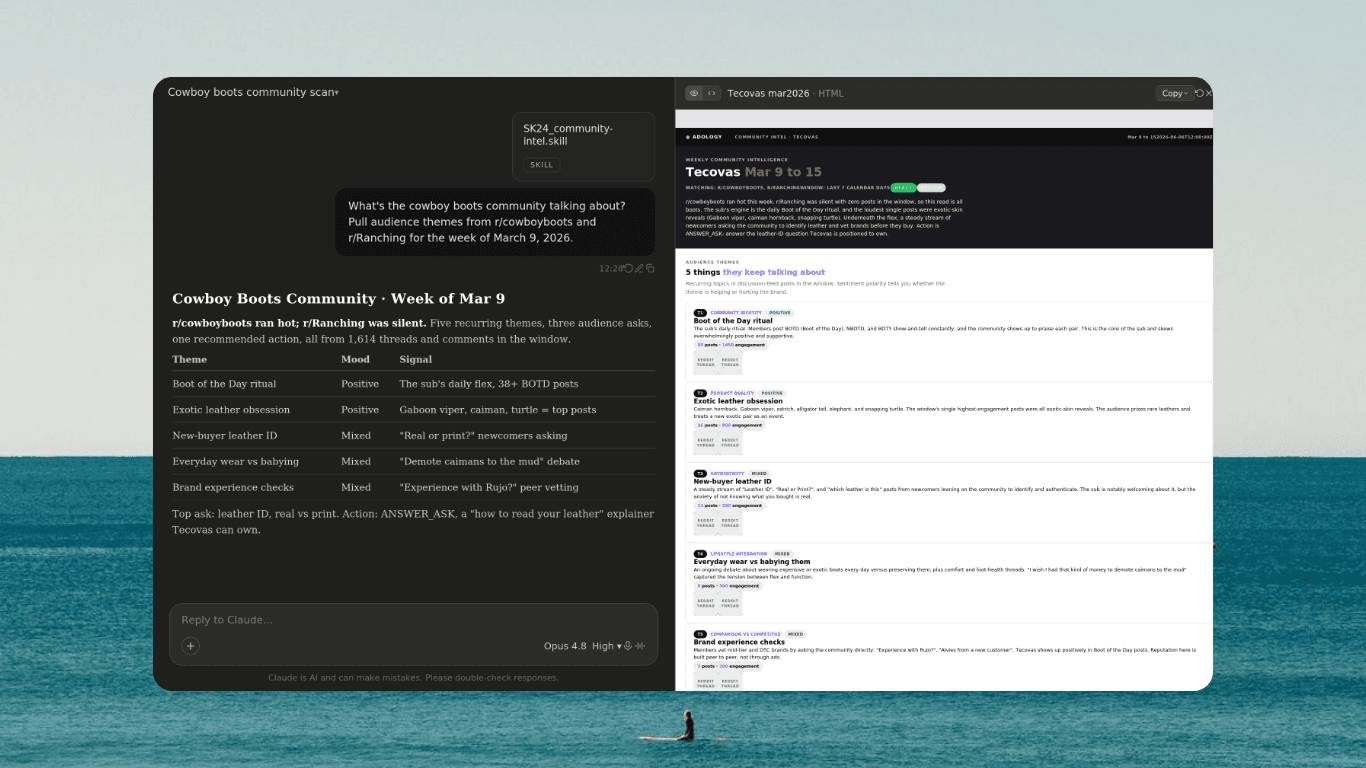
For the week of March 9, r/cowboyboots revolved around a daily "Boot of the Day" ritual, with strong interest in exotic skins and heritage makers. Three questions kept coming up:
Leather ID
Brand vetting
Everyday-wear comfort
Answer those well, and you're useful to the exact people you're trying to reach. The read came back MEDIUM confidence, since one of the two subreddits stayed quiet that week. Tecovas showed up: one post, 94 likes, 4 comments, while exotic-boot posts moved past 300. That's a visibility gap where your buyers are actively talking about the category, and you won't fix it until you know it's there.
Prompt example: "What's the [named community] talking about? Pull audience themes from [r/redditname] and [r/redditname] for the week of [date]."
7. Creative toolkits
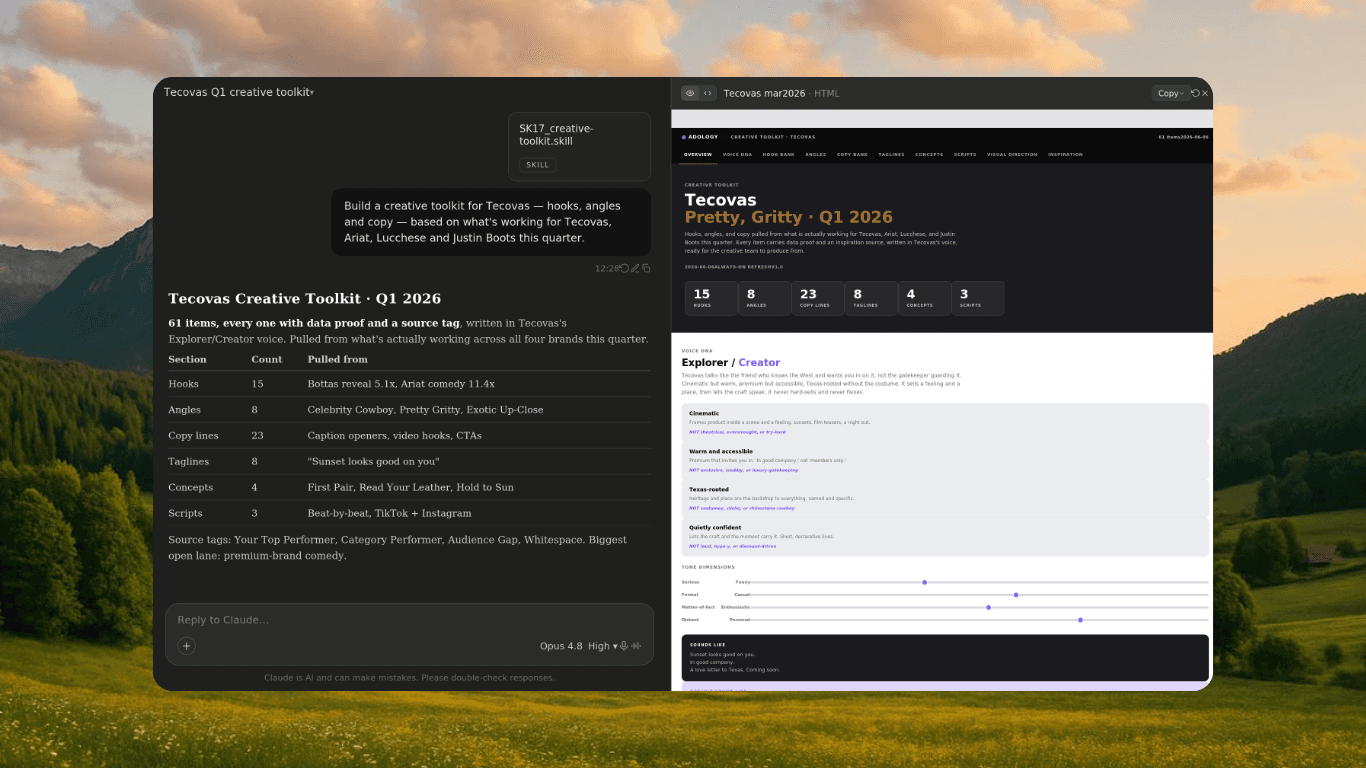
This is where reading becomes making. Adology MCP turned the market read into a creative toolkit: 1 Voice DNA card, 15 hooks, 8 angles, 23 copy lines, and 8 taglines. Each asset was tagged by its origin: a top performer, a category winner, an audience gap, or open whitespace.
The “Unexpected Western” angle carried its receipt: the Bottas partnership at 43,135 likes, 5.1x average. That matters because creative recommendations should not float without evidence. The best toolkit tells the team what to make and why the idea has a right to exist.
Prompt example:
“Build a creative toolkit for [your brand], hooks, angles, and copy, based on what’s working for [competitors] this quarter.”
8. New-business pitch intelligence
Pitch prep shouldn't be a pile of facts. You win new business by showing the prospect you already understand their business. That normally takes days of research, which a team rarely has before a pitch. Adology MCP does that research and turns it into a point of view you can put straight in front of the client.
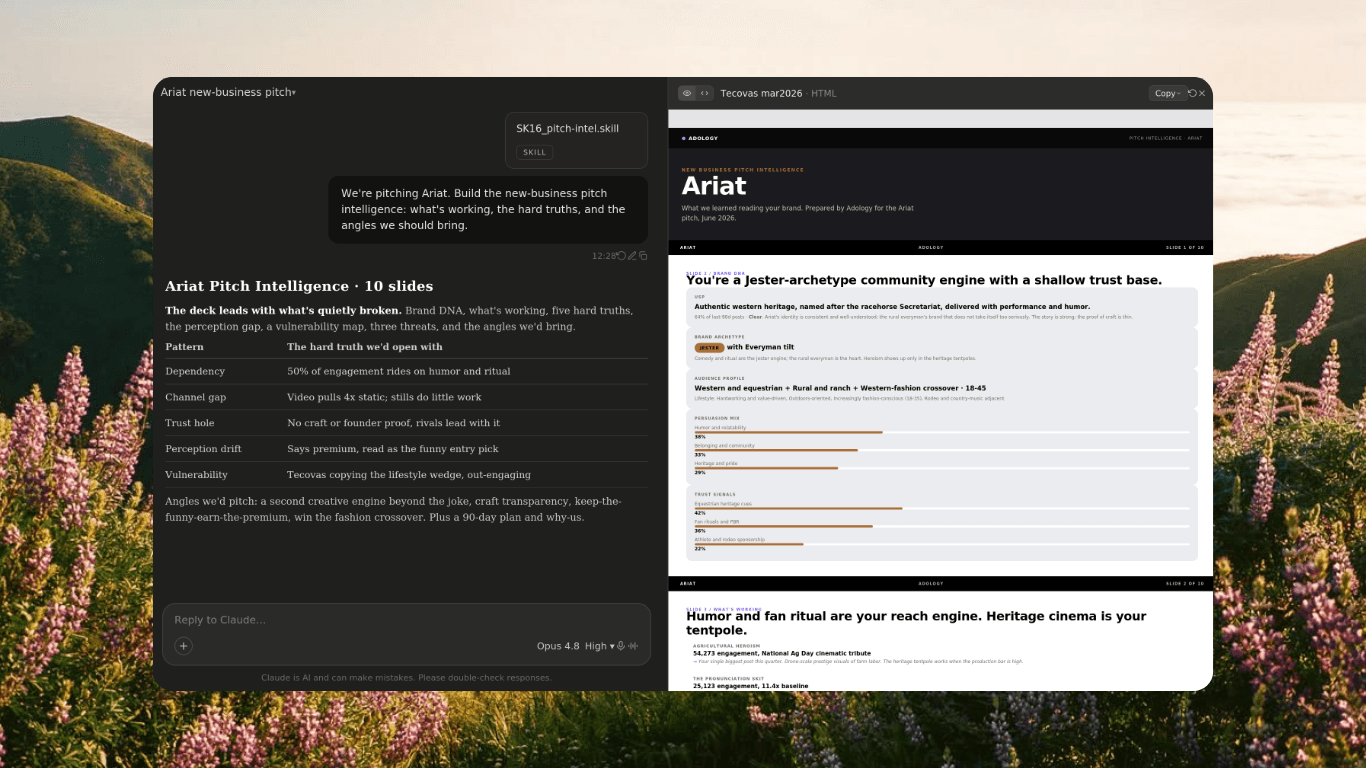
For an Ariat pitch, the center slide named four hard truths:
70% of engagement came from culture and fan-ritual content, with no product fallback.
The trust mix skipped the craftsmanship story that competitors lead with.
The workwear position had drifted into a meme reputation.
A competitor was renting Ariat's community-sponsorship wedge.
Specifics like these win the room. They show you understood the brand well enough to tell it something it didn't already know. It gave four truths it could back up instead of padding to five. In a pitch, that's what you want: if one claim is weak, the client catches it and stops trusting the rest.
Prompt example: "We're pitching [brand]. Build the new-business pitch intelligence: what's working, the hard truths, and the unique angles we should bring."
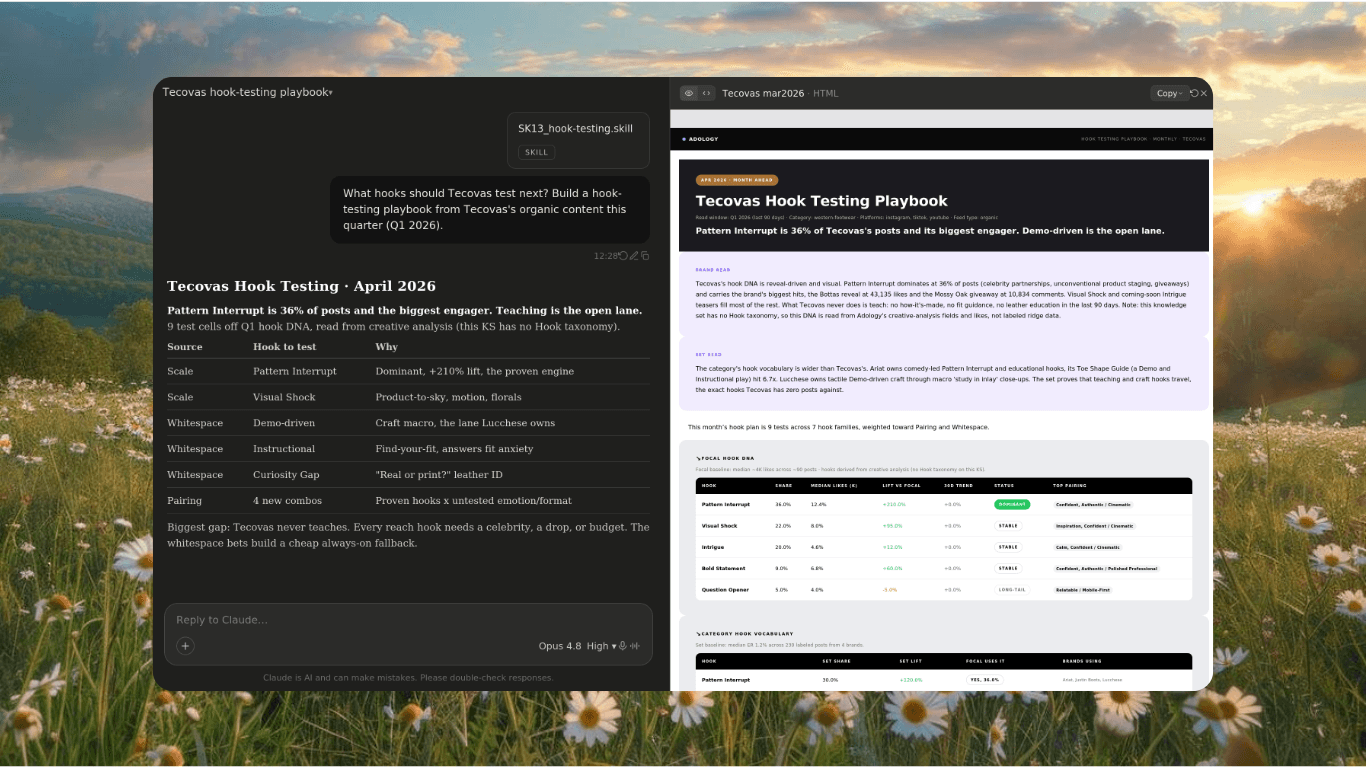
9. Hook test plans
A hook bank shouldn't just rank what worked. It should tell the team what to test next. Knowing your best-performing hook is backward-looking. On its own, it doesn't change what you post next week. A test plan does: it turns the ranking into decisions about the next content cycle.
For Tecovas, Pattern Interrupt made up about 36% of posts and drove the most engagement, making it the strongest opener already in the mix. The plan was built on that pattern rather than copying any single top post, since one viral post is a fluke, not a strategy. The aim was to run more of what consistently works and pull the rest of the calendar toward it.
That becomes a short list of tests:
Which Pattern Interrupt hooks should be repeated?
Which product stories deserve the opener?
Which weaker hook types should be cut back?
Which assumptions need another round of proof?
Only 55 posts were labeled in the window, so the findings came back directional. The tests are built to confirm the read before anyone commits the calendar to it.
Prompt example: "What hooks should [your brand] test next? Build a hook-testing playbook from [your brand's] organic content this quarter."
10. Competitive positioning maps
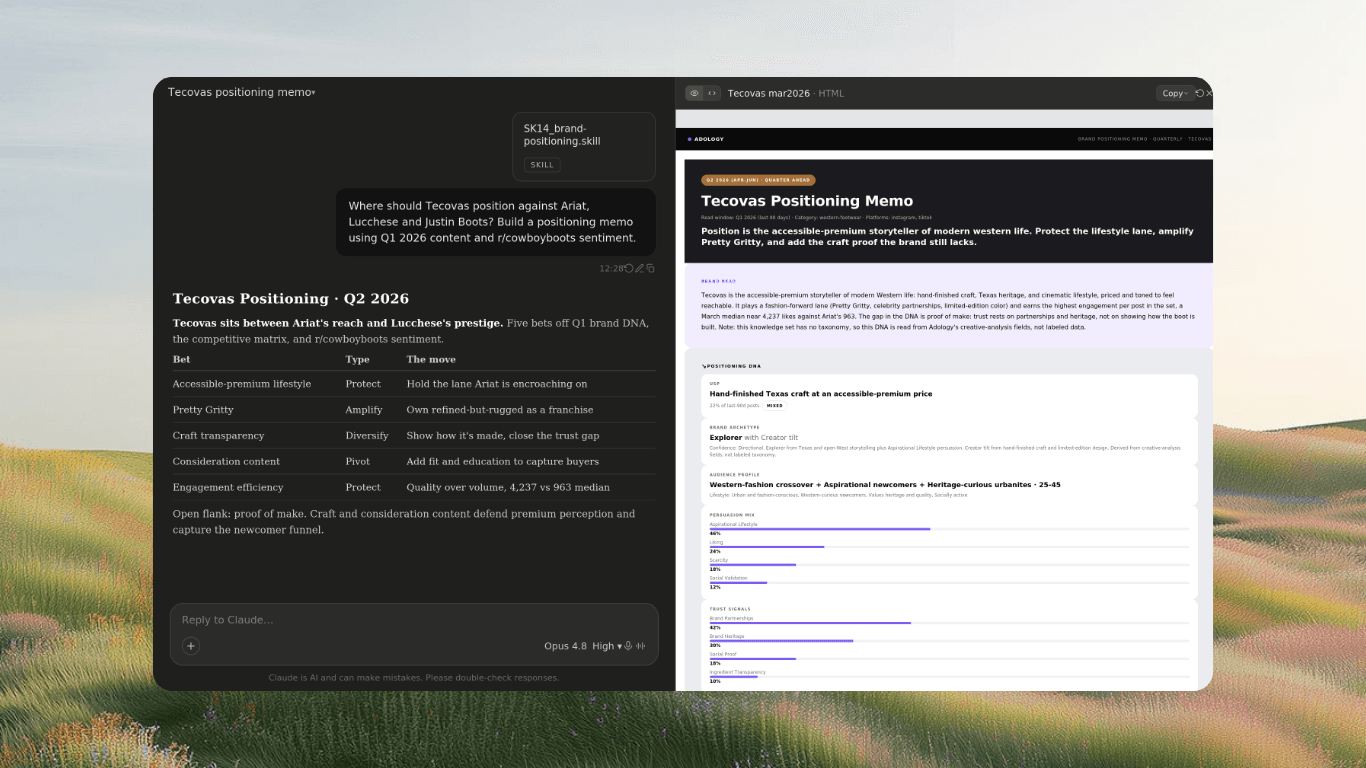
Positioning is the biggest bet a brand makes. It sets the creative, the spend, and the messaging that follow, and choosing a lane a competitor already owns is how you spend a year losing a fight you didn't need to pick. The useful question isn't "who are we?" It's "what's actually open?" Adology MCP mapped Tecovas against Ariat, Lucchese, and Justin Boots, and most of the ground was already claimed:
Lucchese owned the high-end, grail-boot tier.
Ariat owned the mainstream-culture lane.
Justin owned the worksite.
That left one lane open for Tecovas: the entry point. The brand for someone's first real pair of boots, one that teaches and welcomes newcomers, wrapped in a Texas identity that the other three can't easily copy. The map didn't guess at that. It reads off what competitors actually own and what the community actually talks about.
It also flagged the catch. In the community data, Tecovas's standard line was respected but rarely discussed, while its exotics drove the conversation. So the open lane comes with a known risk, and the map puts that in front of you before you commit the budget.
Prompt example: "Where should [your brand] position against [competitors]? Build a positioning memo using Q1 [year] content and [r/redditname] sentiment."
1. Brand health scoring
Is your brand's reputation actually improving, or just getting louder? A brand health scorecard tells you which. Reputation is a leading indicator. It moves weeks before sales or pipeline do, so a tracked score catches a slide early, while it's still cheap to fix. It also gives you a real number to bring to leadership when they ask whether the work is landing.
Adology MCP grades the brand and shows the inputs behind the grade. When something feels soft, you can see which driver actually dropped and spend against that instead of guessing. In one run, Tecovas scored 90 overall, up 21.7% month over month. The read came back MEDIUM confidence, because it only had one month to compare against the prior one.
A score like that only means something in context. Ninety against Ariat, Lucchese, and Justin Boots tells you whether you're leading the category or holding position. And the confidence flag does real work: it tells you how far to trust a single month before you reorganize a budget around it.
Prompt example: "Run a brand health scorecard for [your brand] against [competitor 1,2,3], comparing [month] to [month]."
2. Weekly competitive briefings
The Monday-morning read shouldn't be a screenshot folder. Right now, the competitive scan either doesn't happen, because nobody has a spare morning, or it lands as "here's what they posted" with no read on what to do. So you find out a rival's move worked once it's already everywhere, and you spend the quarter reacting to things you could have seen coming.
Adology MCP pulls the week's competitor activity, ranks what actually mattered, and tells you what to do about it. This run: Ariat owned 19 of the 38 posts in the set, and its country mule drop pulled 19,148 engagements at 8.8x its baseline on a Pattern Interrupt hook.
It didn't stop at "Ariat had a good week." It called for a counter-move. That means you start Monday with a decision instead of a research task, and when leadership asks what the competition is doing, you have a ranked answer and the receipts to back it. Plenty of dashboards tell you what happened last week. Far fewer hand you a move for Tuesday.
Prompt example: "Give me a weekly competitive briefing for [your brand] vs [competitor 1,2,3] for the week of [date]."
3. Monthly intelligence deep-dives
Sometimes the week is too small. A week shows you what your competitors posted. A month shows you what they're betting on: a hook strategy shifting, a narrative taking over, share of voice changing hands. None of that is visible in a seven-day window. It's also where you catch your own drift, the slow slide in output or reach that nobody notices from the inside until it gets counted.
In this run, Lucchese's share of voice climbed 30.7 points on a "The Reveal" narrative. Ariat shifted toward Pattern Interrupt hooks. Tecovas went quiet: 29 posts, down from 88 the month before, which is exactly the kind of thing a brand rarely catches about itself.
The workflow also flagged what it couldn't analyze: there was no paid ad data in the set. Missing data gets called missing, not dressed up as insight, so you know where the read is solid and where it has a blind spot. And it lands on the cadence marketing actually runs on, so it slots into the monthly review and budget planning instead of becoming one more thing to pull together the night before.
Prompt example: "Build a monthly competitive intelligence briefing for [your brand] and its competitors for [month]."
4. Organic performance analysis
Paid data can hide a lot. Organic makes the category’s actual taste easier to see. In this run, the western boots set moved away from Demonstration content and converged on Product Journey and Community Spotlight formats. Ariat led on reach with an Ag Day post at 52,700. Tecovas posted the least, but held the highest median likes at 1,080.
The likes read was marked as "directional" because likes were not captured for part of the month. That is what a useful read should do: show the pattern, then tell the team how much confidence to put behind it.
Prompt example:
“What are [your brand's] competitors doing differently this month? Compare [competitors], [month to month].”
5. Influencer vetting
Creator fit shouldn't start and end with follower count. A big following tells you reach, not whether their audience is your audience, and it says nothing about the risks that sink a partnership after you've paid. A creator deal is slow and expensive to unwind. The valuable moment to catch a dealbreaker is before you sign.
Ask Adology MCP to analyze a creator and a brand, and it returns a verdict with the reasoning attached. For Dale Brisby against Tecovas: a Fit Score of 85 and a verdict of Maybe. The content fit was strong, his Cowboy Culture and Rodeo Community audience mapping closely to the people Tecovas wants to reach, and one stunt post hit 59,905 likes, 337x his average.
The "Maybe" came from a single red flag: he posted 42 times in February, then went dark. That's the kind of thing a media kit won't tell you, and a quick scroll of his grid won't surface. So the recommendation wasn't "sign him." It was "confirm he's still active before committing," which is a call you can actually defend to whoever holds the budget.
Prompt example: "Should [your brand] work with [creator]? Vet [creator] using [his/her/their] recent content from [date/month/year]."
6. Community sentiment reads
Brand feeds show what brands want to say. Communities show what audiences actually care about. You can't see any of this from your own channels. The questions a community keeps asking tell you exactly what your content should cover. And the same read shows whether your brand is even present where your buyers spend their time.
For the week of March 9, r/cowboyboots revolved around a daily "Boot of the Day" ritual, with strong interest in exotic skins and heritage makers. Three questions kept coming up:
Leather ID
Brand vetting
Everyday-wear comfort
Answer those well, and you're useful to the exact people you're trying to reach. The read came back MEDIUM confidence, since one of the two subreddits stayed quiet that week. Tecovas showed up: one post, 94 likes, 4 comments, while exotic-boot posts moved past 300. That's a visibility gap where your buyers are actively talking about the category, and you won't fix it until you know it's there.
Prompt example: "What's the [named community] talking about? Pull audience themes from [r/redditname] and [r/redditname] for the week of [date]."
7. Creative toolkits
This is where reading becomes making. Adology MCP turned the market read into a creative toolkit: 1 Voice DNA card, 15 hooks, 8 angles, 23 copy lines, and 8 taglines. Each asset was tagged by its origin: a top performer, a category winner, an audience gap, or open whitespace.
The “Unexpected Western” angle carried its receipt: the Bottas partnership at 43,135 likes, 5.1x average. That matters because creative recommendations should not float without evidence. The best toolkit tells the team what to make and why the idea has a right to exist.
Prompt example:
“Build a creative toolkit for [your brand], hooks, angles, and copy, based on what’s working for [competitors] this quarter.”
8. New-business pitch intelligence
Pitch prep shouldn't be a pile of facts. You win new business by showing the prospect you already understand their business. That normally takes days of research, which a team rarely has before a pitch. Adology MCP does that research and turns it into a point of view you can put straight in front of the client.
For an Ariat pitch, the center slide named four hard truths:
70% of engagement came from culture and fan-ritual content, with no product fallback.
The trust mix skipped the craftsmanship story that competitors lead with.
The workwear position had drifted into a meme reputation.
A competitor was renting Ariat's community-sponsorship wedge.
Specifics like these win the room. They show you understood the brand well enough to tell it something it didn't already know. It gave four truths it could back up instead of padding to five. In a pitch, that's what you want: if one claim is weak, the client catches it and stops trusting the rest.
Prompt example: "We're pitching [brand]. Build the new-business pitch intelligence: what's working, the hard truths, and the unique angles we should bring."
9. Hook test plans
A hook bank shouldn't just rank what worked. It should tell the team what to test next. Knowing your best-performing hook is backward-looking. On its own, it doesn't change what you post next week. A test plan does: it turns the ranking into decisions about the next content cycle.
For Tecovas, Pattern Interrupt made up about 36% of posts and drove the most engagement, making it the strongest opener already in the mix. The plan was built on that pattern rather than copying any single top post, since one viral post is a fluke, not a strategy. The aim was to run more of what consistently works and pull the rest of the calendar toward it.
That becomes a short list of tests:
Which Pattern Interrupt hooks should be repeated?
Which product stories deserve the opener?
Which weaker hook types should be cut back?
Which assumptions need another round of proof?
Only 55 posts were labeled in the window, so the findings came back directional. The tests are built to confirm the read before anyone commits the calendar to it.
Prompt example: "What hooks should [your brand] test next? Build a hook-testing playbook from [your brand's] organic content this quarter."
10. Competitive positioning maps
Positioning is the biggest bet a brand makes. It sets the creative, the spend, and the messaging that follow, and choosing a lane a competitor already owns is how you spend a year losing a fight you didn't need to pick. The useful question isn't "who are we?" It's "what's actually open?" Adology MCP mapped Tecovas against Ariat, Lucchese, and Justin Boots, and most of the ground was already claimed:
Lucchese owned the high-end, grail-boot tier.
Ariat owned the mainstream-culture lane.
Justin owned the worksite.
That left one lane open for Tecovas: the entry point. The brand for someone's first real pair of boots, one that teaches and welcomes newcomers, wrapped in a Texas identity that the other three can't easily copy. The map didn't guess at that. It reads off what competitors actually own and what the community actually talks about.
It also flagged the catch. In the community data, Tecovas's standard line was respected but rarely discussed, while its exotics drove the conversation. So the open lane comes with a known risk, and the map puts that in front of you before you commit the budget.
Prompt example: "Where should [your brand] position against [competitors]? Build a positioning memo using Q1 [year] content and [r/redditname] sentiment."
How to start even without Adology MCP
How to start even without Adology MCP
You do not need a full system to start thinking this way.
Here is the manual version:
Pick one focal brand and three competitors.
Track one fixed window, such as the last 30 or 90 days.
Capture only three things at first: what changed, what performed, and what the next move should be.
Separate evidence from interpretation. Do not let a strong opinion pretend to be a supported read.
Add a confidence note when the data is incomplete.
The manual version works for a while. It starts to break when the market moves faster than the team can review, classify, and turn signals into work. That is where Adology MCP becomes useful: it keeps the same discipline, but makes the loop repeatable.
You do not need a full system to start thinking this way.
Here is the manual version:
Pick one focal brand and three competitors.
Track one fixed window, such as the last 30 or 90 days.
Capture only three things at first: what changed, what performed, and what the next move should be.
Separate evidence from interpretation. Do not let a strong opinion pretend to be a supported read.
Add a confidence note when the data is incomplete.
The manual version works for a while. It starts to break when the market moves faster than the team can review, classify, and turn signals into work. That is where Adology MCP becomes useful: it keeps the same discipline, but makes the loop repeatable.
The takeaway? Adology MCP turns signals into work
The takeaway? Adology MCP turns signals into work
Whether you are in beauty or finance, our top ten Adology MCP use case examples can be used across any market to study what's happening, turn it into work your team can ship, and check the call against the people you're trying to reach.
Make it a weekly habit, and the market stops surprising you. Your scorecards stay current. Your briefs start from what's already working. Your positioning targets a gap you can actually see.
Whether you are in beauty or finance, our top ten Adology MCP use case examples can be used across any market to study what's happening, turn it into work your team can ship, and check the call against the people you're trying to reach.
Make it a weekly habit, and the market stops surprising you. Your scorecards stay current. Your briefs start from what's already working. Your positioning targets a gap you can actually see.
How to get started
How to get started
Want to see Adology MCP run on your category?
Send us your brand and three or four competitors. We'll do the first intelligence pass and show you exactly what it surfaces. Book it here!
Want to see Adology MCP run on your category?
Send us your brand and three or four competitors. We'll do the first intelligence pass and show you exactly what it surfaces. Book it here!
Frequently Asked Questions
Frequently Asked Questions
What is Adology MCP?
Adology MCP connects AI tools to Adology’s marketing intelligence workflows so teams can run analysis against live category context instead of a blank chat window. It helps turn market signals into usable outputs like scorecards, weekly briefs, creative toolkits, hook test plans, and positioning memos.
What is a knowledge set in Adology?
A knowledge set is the market context Adology MCP uses for analysis. It can include a focal brand, competitor set, content history, community sources, creator activity, and other classified signals that help the system produce grounded recommendations.
How is Adology MCP different from a normal AI chatbot?
A normal AI chatbot can produce a polished answer, but it often works from general knowledge or whatever the user pastes into the thread. Adology MCP works from structured market intelligence and returns client-ready outputs with evidence, confidence levels, and data gaps included.
How often should marketing teams run competitive intelligence workflows?
Marketing teams should run lightweight competitive intelligence weekly and deeper analysis monthly. Weekly reads catch movement while it is still actionable, while monthly deep-dives reveal bigger shifts in share of voice, hooks, formats, positioning, and audience conversation.
What is the Signal-to-Work Loop?
The Signal-to-Work Loop is Adology’s framework for turning market signals into usable marketing work. It means studying the market, shipping the signal into a deliverable, and checking whether the recommendation was supported by evidence.
What can Adology MCP produce for a marketing team?
Adology MCP can produce brand health scorecards, weekly competitive briefings, monthly intelligence deep-dives, organic performance reads, influencer vetting, community sentiment reads, creative toolkits, new-business pitch intelligence, hook test plans, and competitive positioning maps.
What is Adology MCP?
Adology MCP connects AI tools to Adology’s marketing intelligence workflows so teams can run analysis against live category context instead of a blank chat window. It helps turn market signals into usable outputs like scorecards, weekly briefs, creative toolkits, hook test plans, and positioning memos.
What is a knowledge set in Adology?
A knowledge set is the market context Adology MCP uses for analysis. It can include a focal brand, competitor set, content history, community sources, creator activity, and other classified signals that help the system produce grounded recommendations.
How is Adology MCP different from a normal AI chatbot?
A normal AI chatbot can produce a polished answer, but it often works from general knowledge or whatever the user pastes into the thread. Adology MCP works from structured market intelligence and returns client-ready outputs with evidence, confidence levels, and data gaps included.
How often should marketing teams run competitive intelligence workflows?
Marketing teams should run lightweight competitive intelligence weekly and deeper analysis monthly. Weekly reads catch movement while it is still actionable, while monthly deep-dives reveal bigger shifts in share of voice, hooks, formats, positioning, and audience conversation.
What is the Signal-to-Work Loop?
The Signal-to-Work Loop is Adology’s framework for turning market signals into usable marketing work. It means studying the market, shipping the signal into a deliverable, and checking whether the recommendation was supported by evidence.
What can Adology MCP produce for a marketing team?
Adology MCP can produce brand health scorecards, weekly competitive briefings, monthly intelligence deep-dives, organic performance reads, influencer vetting, community sentiment reads, creative toolkits, new-business pitch intelligence, hook test plans, and competitive positioning maps.

How to Analyze What Social Listening Misses in Video Posts
How to Analyze What Social Listening Misses in Video Posts

How to Build a Competitive Creative Briefing Executives Will Actually Use
How to Build a Competitive Creative Briefing Executives Will Actually Use

Your Swipe File Is Dysfunctional. Let’s Fix It
Your Swipe File Is Dysfunctional. Let’s Fix It

Why Better Prompts Don’t Fix Generic Marketing Advice
Why Better Prompts Don’t Fix Generic Marketing Advice

How to Benchmark Competitor Creative Against Client Goals
How to Benchmark Competitor Creative Against Client Goals

What Are Hydration Brands Actually Selling?
What Are Hydration Brands Actually Selling?

Is It a Creative Pattern or a Standout Ad?
Is It a Creative Pattern or a Standout Ad?

How to Find Creative Whitespace in Competitor Ads
How to Find Creative Whitespace in Competitor Ads

How to Analyze Competitor Ads With an AI Assistant
How to Analyze Competitor Ads With an AI Assistant
Best Ad Intelligence Tools in 2026: An Honest Breakdown
Best Ad Intelligence Tools in 2026: An Honest Breakdown
The market
The market
is moving right now.
is moving right now.
Your competitors' intelligence is updating. Your next brief will either start from what's actually working in your category this week, or it won't.
Your competitors' intelligence is updating. Your next brief will either start from what's actually working in your category this week, or it won't.
Free signup
Free signup
Pay as you go
Pay as you go
Cancel whenever
Cancel whenever
ADOLOGY AI
ADOLOGY AI
Marketing intelligence that holds itself accountable. Watches your market continuously, ships intelligence into your workflows, grades itself on every call.
Marketing intelligence that holds itself accountable. Watches your market continuously, ships intelligence into your workflows, grades itself on every call.
ADOLOGY
© 2026 Adology. All rights reserved.
© 2026 Adology. All rights reserved.