Back
Back
Is It a Creative Pattern or a Standout Ad?
Is It a Creative Pattern or a Standout Ad?

Table of Contents
THE SHORT ANSWER A creative pattern is a repeated creative choice visible across a meaningful set of comparable executions. One standout ad gives you a hypothesis. Before you treat it as a pattern, check recurrence, breadth, time, baseline, and the exact creative element that repeats. |
|---|
Someone drops a competitor ad into Slack.
“We should test this.”
The post has three times the engagement of most other content on the account. By the time the creative brief arrives, the example has become evidence that “this format is working.”
Maybe it is. The concept may be strong. The creator may have brought unusual distribution. The timing may have helped. The account may have had an outlier.
Before you turn one example into a creative direction, you need to know whether the creative choice repeats elsewhere.
THE SHORT ANSWER A creative pattern is a repeated creative choice visible across a meaningful set of comparable executions. One standout ad gives you a hypothesis. Before you treat it as a pattern, check recurrence, breadth, time, baseline, and the exact creative element that repeats. |
|---|
Someone drops a competitor ad into Slack.
“We should test this.”
The post has three times the engagement of most other content on the account. By the time the creative brief arrives, the example has become evidence that “this format is working.”
Maybe it is. The concept may be strong. The creator may have brought unusual distribution. The timing may have helped. The account may have had an outlier.
Before you turn one example into a creative direction, you need to know whether the creative choice repeats elsewhere.
One ad gives you a hypothesis, not a pattern
One ad gives you a hypothesis, not a pattern
An individual ad is one execution. It can be worth studying without representing anything broader.
A creative pattern appears when the same underlying choice shows up more than once and still makes sense after you compare it with other executions, time periods, or competitors.
The repeating choice might be:
the hook structure that earns attention;
the main message or promise;
the type of proof used to make the claim believable;
the format or visual device;
the creator’s role in the story;
the offer or reason to act;
the audience situation being addressed.
This distinction matters because teams often copy the most visible part of a standout ad. The useful pattern may sit underneath it.
An individual ad is one execution. It can be worth studying without representing anything broader.
A creative pattern appears when the same underlying choice shows up more than once and still makes sense after you compare it with other executions, time periods, or competitors.
The repeating choice might be:
the hook structure that earns attention;
the main message or promise;
the type of proof used to make the claim believable;
the format or visual device;
the creator’s role in the story;
the offer or reason to act;
the audience situation being addressed.
This distinction matters because teams often copy the most visible part of a standout ad. The useful pattern may sit underneath it.
Check whether the creative choice repeats
Check whether the creative choice repeats
Start by separating the ad from the thing you think is interesting about it. Then ask whether that choice appears again.
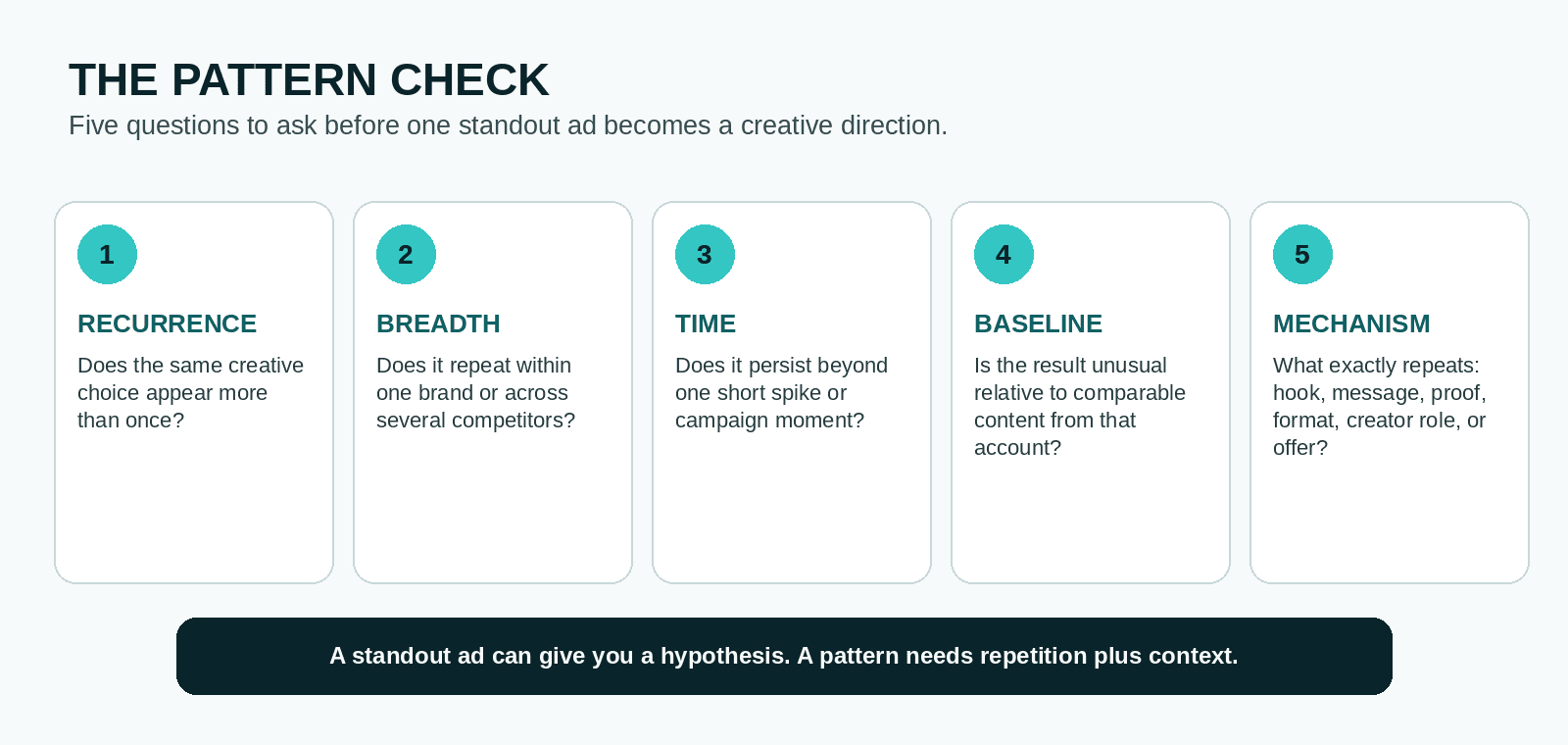
The Pattern Check keeps one impressive example from turning into a category claim too quickly.
You do not need every answer to be yes. A pattern can begin inside one brand before it appears across a category. The point is to know how much evidence sits behind the claim you are making.
Illustrative example
Imagine a competitor creator video generates three times the account’s median public engagement. The video opens on a common customer problem, then moves into a demonstration.
If the next six posts use different hooks, different proof, and different formats, the original video may be an outlier. If several later ads return to the same problem-first opening, and those executions repeatedly stand above comparable content, you now have a stronger brand-level pattern to investigate.
The pattern is the repeated creative choice. The original post is only the first piece of evidence.
Start by separating the ad from the thing you think is interesting about it. Then ask whether that choice appears again.
The Pattern Check keeps one impressive example from turning into a category claim too quickly.
You do not need every answer to be yes. A pattern can begin inside one brand before it appears across a category. The point is to know how much evidence sits behind the claim you are making.
Illustrative example
Imagine a competitor creator video generates three times the account’s median public engagement. The video opens on a common customer problem, then moves into a demonstration.
If the next six posts use different hooks, different proof, and different formats, the original video may be an outlier. If several later ads return to the same problem-first opening, and those executions repeatedly stand above comparable content, you now have a stronger brand-level pattern to investigate.
The pattern is the repeated creative choice. The original post is only the first piece of evidence.
Compare the ad with the right baseline
Compare the ad with the right baseline
Absolute numbers can make an ad look impressive while hiding the context that matters.
A post with 50,000 engagements may be ordinary for an account that usually receives 70,000. A post with 4,000 may be unusual for an account whose comparable content typically receives 500.
When you evaluate a standout ad, define the baseline before you use a multiplier or call the result unusual. State the account, metric, comparison window, and whether the baseline is a mean, median, or another defined reference point.
BASELINE RULE Use a baseline to judge whether a result is unusual for that account or comparison set. Do not treat an unexplained multiple as evidence by itself. |
|---|
Absolute numbers can make an ad look impressive while hiding the context that matters.
A post with 50,000 engagements may be ordinary for an account that usually receives 70,000. A post with 4,000 may be unusual for an account whose comparable content typically receives 500.
When you evaluate a standout ad, define the baseline before you use a multiplier or call the result unusual. State the account, metric, comparison window, and whether the baseline is a mean, median, or another defined reference point.
BASELINE RULE Use a baseline to judge whether a result is unusual for that account or comparison set. Do not treat an unexplained multiple as evidence by itself. |
|---|
Separate the pattern from the execution
Separate the pattern from the execution
Three competitor ads can look completely different while sharing the same strategic choice.
One may use a creator. Another may use a product close-up. A third may use a text-led carousel. If all three open with the same customer problem before introducing the product, the repeated pattern may be the hook structure rather than the creator, visual style, or platform format.
A useful review asks two different questions:
What is unique to this execution?
What underlying choice also appears elsewhere?
That prevents the brief from copying surface details that happened to travel with the result.
Three competitor ads can look completely different while sharing the same strategic choice.
One may use a creator. Another may use a product close-up. A third may use a text-led carousel. If all three open with the same customer problem before introducing the product, the repeated pattern may be the hook structure rather than the creator, visual style, or platform format.
A useful review asks two different questions:
What is unique to this execution?
What underlying choice also appears elsewhere?
That prevents the brief from copying surface details that happened to travel with the result.
Look across three levels of evidence
Look across three levels of evidence
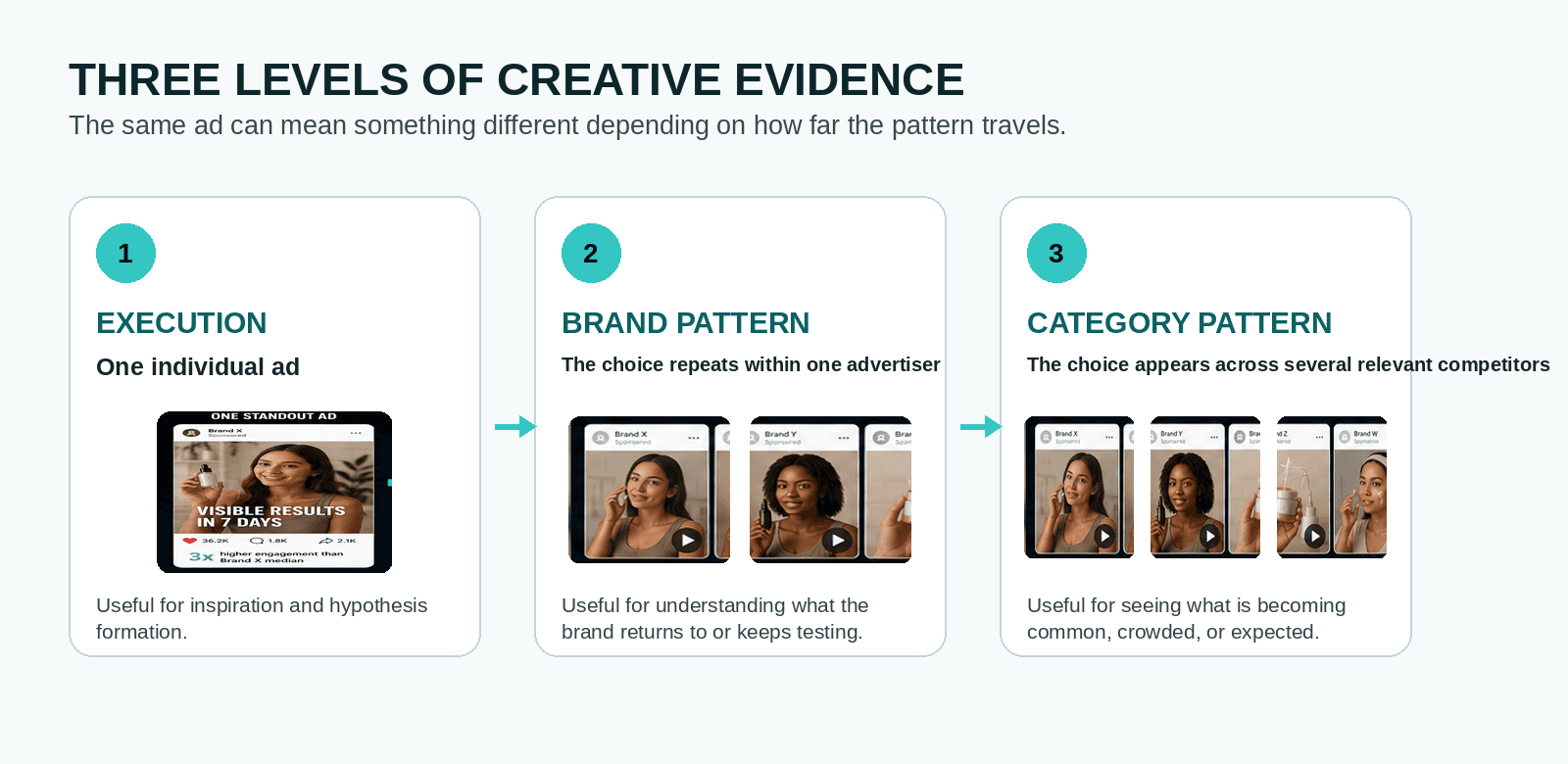
A pattern becomes more useful as you become clearer about the level at which it repeats.
An execution can be useful even when it never becomes a broader pattern. It can inspire a hypothesis or a test. A brand pattern tells you that one advertiser keeps returning to a creative choice. A category pattern tells you that several relevant competitors are converging on the same territory.
Those three levels lead to different decisions. A one-off example may be worth testing. A brand pattern may reveal what a competitor keeps prioritizing. A category pattern can help you identify what is becoming expected or crowded.
A pattern becomes more useful as you become clearer about the level at which it repeats.
An execution can be useful even when it never becomes a broader pattern. It can inspire a hypothesis or a test. A brand pattern tells you that one advertiser keeps returning to a creative choice. A category pattern tells you that several relevant competitors are converging on the same territory.
Those three levels lead to different decisions. A one-off example may be worth testing. A brand pattern may reveal what a competitor keeps prioritizing. A category pattern can help you identify what is becoming expected or crowded.
Fix the time window before you call the trend
Fix the time window before you call the trend
Creative behavior changes quickly. A pattern that appears during a launch week may disappear once the campaign moves on.
Write the comparison window into the analysis. “This hook is common” means very little without knowing whether the observation covers seven days, 30 days, a quarter, or a historical library.
Time also helps separate persistence from a short spike. If a pattern survives across several creative cycles, it deserves more attention than an idea that appeared only around one promotion or cultural moment.
Creative behavior changes quickly. A pattern that appears during a launch week may disappear once the campaign moves on.
Write the comparison window into the analysis. “This hook is common” means very little without knowing whether the observation covers seven days, 30 days, a quarter, or a historical library.
Time also helps separate persistence from a short spike. If a pattern survives across several creative cycles, it deserves more attention than an idea that appeared only around one promotion or cultural moment.
Use public engagement as a signal, not a business outcome
Use public engagement as a signal, not a business outcome
Public engagement can help you see which posts stood out within an observable dataset. It can also help you compare distribution and response when the metric is captured consistently.
Public engagement does not independently establish sales, ROAS, CPA, conversion lift, brand lift, or the competitor’s private spend and targeting. Those outcomes require first-party or otherwise appropriate business data.
Public signal | Useful for | Does not prove |
|---|---|---|
Post-level engagement | Which posts stood out within the observed set | Sales, ROAS, CPA, or causal business impact |
Repeated hook or format | Whether a creative choice recurs | That the pattern caused stronger performance |
Cross-brand recurrence | Whether the category is converging on a choice | That every brand should copy it |
Time persistence | Whether the pattern survives beyond a short spike | That the pattern will remain effective |
Public engagement can help you see which posts stood out within an observable dataset. It can also help you compare distribution and response when the metric is captured consistently.
Public engagement does not independently establish sales, ROAS, CPA, conversion lift, brand lift, or the competitor’s private spend and targeting. Those outcomes require first-party or otherwise appropriate business data.
Public signal | Useful for | Does not prove |
|---|---|---|
Post-level engagement | Which posts stood out within the observed set | Sales, ROAS, CPA, or causal business impact |
Repeated hook or format | Whether a creative choice recurs | That the pattern caused stronger performance |
Cross-brand recurrence | Whether the category is converging on a choice | That every brand should copy it |
Time persistence | Whether the pattern survives beyond a short spike | That the pattern will remain effective |
Turn a pattern into a test, not a copy
Turn a pattern into a test, not a copy
Once a pattern survives the checks, the next job is to turn it into something your team can test without reproducing the competitor’s execution.
A useful handoff contains four pieces:
Observed pattern: name the creative choice that repeats and the comparison set where you saw it.
Working explanation: state why the choice may matter, while keeping interpretation separate from the observed evidence.
Creative translation: define two or three executions that express the same underlying principle in your brand’s own voice and visual system.
Measurement plan: choose the metric and comparison that will tell you whether the hypothesis deserves another round.
If the pattern is “problem-first hooks repeatedly stand out,” the test is not “copy Brand X’s creator ad.” The test is to build several brand-appropriate executions that open on a meaningful customer problem and compare them with the current control.
Once a pattern survives the checks, the next job is to turn it into something your team can test without reproducing the competitor’s execution.
A useful handoff contains four pieces:
Observed pattern: name the creative choice that repeats and the comparison set where you saw it.
Working explanation: state why the choice may matter, while keeping interpretation separate from the observed evidence.
Creative translation: define two or three executions that express the same underlying principle in your brand’s own voice and visual system.
Measurement plan: choose the metric and comparison that will tell you whether the hypothesis deserves another round.
If the pattern is “problem-first hooks repeatedly stand out,” the test is not “copy Brand X’s creator ad.” The test is to build several brand-appropriate executions that open on a meaningful customer problem and compare them with the current control.
You can run the pattern check manually
You can run the pattern check manually
A spreadsheet is enough to start. Keep one row per ad and capture the creative dimensions that matter to the brief.
brand and date;
platform or source;
hook;
message;
proof;
format;
visual device;
creator role;
offer;
public metric and defined baseline, when available.
Then sort the sheet by the creative choice you are testing. The point is to compare like with like rather than scroll a folder until something feels familiar.
A spreadsheet is enough to start. Keep one row per ad and capture the creative dimensions that matter to the brief.
brand and date;
platform or source;
hook;
message;
proof;
format;
visual device;
creator role;
offer;
public metric and defined baseline, when available.
Then sort the sheet by the creative choice you are testing. The point is to compare like with like rather than scroll a folder until something feels familiar.
Where Adology can help with the pattern read
Where Adology can help with the pattern read
If your team uses Adology, a defined Knowledge Set can keep the competitive set, sources, and category context together while you review recurring hooks, formats, messages, creators, and other labeled signals across brands.
Adology’s current Skills page describes category workflows that produce positioning and whitespace reads, competitive briefs, creative toolkits, and pattern analysis from current market activity. The useful part for this job is reducing the manual work required to organize comparable examples before a strategist decides what the pattern means.
Explore current Adology workflows: Adology Skills
The final decision still belongs in the brief. A tool can organize the evidence. Your team still has to decide whether the pattern fits the audience, the brand, and the test you are trying to run.
If your team uses Adology, a defined Knowledge Set can keep the competitive set, sources, and category context together while you review recurring hooks, formats, messages, creators, and other labeled signals across brands.
Adology’s current Skills page describes category workflows that produce positioning and whitespace reads, competitive briefs, creative toolkits, and pattern analysis from current market activity. The useful part for this job is reducing the manual work required to organize comparable examples before a strategist decides what the pattern means.
Explore current Adology workflows: Adology Skills
The final decision still belongs in the brief. A tool can organize the evidence. Your team still has to decide whether the pattern fits the audience, the brand, and the test you are trying to run.
The question to carry into the next brief
The question to carry into the next brief
A standout ad is worth noticing. The mistake is letting one impressive result become a category rule before you check what repeats.
The next time someone drops a competitor ad into Slack, save the example. Then ask what the creative choice was, where else it appears, how long it has persisted, and whether the result is unusual against a defined baseline.
That turns competitor research from reaction into a better creative question: what is repeating, and what should we test because of it?
A standout ad is worth noticing. The mistake is letting one impressive result become a category rule before you check what repeats.
The next time someone drops a competitor ad into Slack, save the example. Then ask what the creative choice was, where else it appears, how long it has persisted, and whether the result is unusual against a defined baseline.
That turns competitor research from reaction into a better creative question: what is repeating, and what should we test because of it?

How to Analyze What Social Listening Misses in Video Posts
How to Analyze What Social Listening Misses in Video Posts

How to Build a Competitive Creative Briefing Executives Will Actually Use
How to Build a Competitive Creative Briefing Executives Will Actually Use

Your Swipe File Is Dysfunctional. Let’s Fix It
Your Swipe File Is Dysfunctional. Let’s Fix It

Why Better Prompts Don’t Fix Generic Marketing Advice
Why Better Prompts Don’t Fix Generic Marketing Advice

How to Benchmark Competitor Creative Against Client Goals
How to Benchmark Competitor Creative Against Client Goals

What Are Hydration Brands Actually Selling?
What Are Hydration Brands Actually Selling?

How to Find Creative Whitespace in Competitor Ads
How to Find Creative Whitespace in Competitor Ads

How to Analyze Competitor Ads With an AI Assistant
How to Analyze Competitor Ads With an AI Assistant

Best Ad Intelligence Tools in 2026: An Honest Breakdown
Best Ad Intelligence Tools in 2026: An Honest Breakdown

How to Analyze Competitor Ads (Without the Screenshot Grind)
How to Analyze Competitor Ads (Without the Screenshot Grind)
The market
The market
is moving right now.
is moving right now.
Your competitors' intelligence is updating. Your next brief will either start from what's actually working in your category this week, or it won't.
Your competitors' intelligence is updating. Your next brief will either start from what's actually working in your category this week, or it won't.
Free signup
Free signup
Pay as you go
Pay as you go
Cancel whenever
Cancel whenever
ADOLOGY AI
ADOLOGY AI
Marketing intelligence that holds itself accountable. Watches your market continuously, ships intelligence into your workflows, grades itself on every call.
Marketing intelligence that holds itself accountable. Watches your market continuously, ships intelligence into your workflows, grades itself on every call.
ADOLOGY
© 2026 Adology. All rights reserved.
© 2026 Adology. All rights reserved.