Back
Back
How to Find Creative Whitespace in Competitor Ads
How to Find Creative Whitespace in Competitor Ads

Table of Contents
Direct answer Creative whitespace is a relevant creative territory that appears underrepresented across a defined competitive set. Find it by comparing repeated choices across competitors, then testing whether an underused customer need, message, proof, format, audience or point of view is relevant to the customer and credible for your brand. |
|---|
You open the competitor folder before Friday's brief.
There are 180 ads inside it. Half have filenames that start with “Screenshot.” Three people have saved the same creator ad for completely different reasons. Someone has already made a slide called Competitor Inspiration.
The slide after it is called Opportunity. That one is still empty.
The problem usually is not a lack of examples. Examples are easier to collect than patterns are to interpret.
The important word in creative whitespace is relevant. Something being absent does not automatically make it an opportunity. A useful whitespace idea needs to make sense for the audience, fit what your brand can credibly say, and be specific enough to test.
Direct answer Creative whitespace is a relevant creative territory that appears underrepresented across a defined competitive set. Find it by comparing repeated choices across competitors, then testing whether an underused customer need, message, proof, format, audience or point of view is relevant to the customer and credible for your brand. |
|---|
You open the competitor folder before Friday's brief.
There are 180 ads inside it. Half have filenames that start with “Screenshot.” Three people have saved the same creator ad for completely different reasons. Someone has already made a slide called Competitor Inspiration.
The slide after it is called Opportunity. That one is still empty.
The problem usually is not a lack of examples. Examples are easier to collect than patterns are to interpret.
The important word in creative whitespace is relevant. Something being absent does not automatically make it an opportunity. A useful whitespace idea needs to make sense for the audience, fit what your brand can credibly say, and be specific enough to test.
Start with a competitive set you can compare
Start with a competitive set you can compare
Creative whitespace is difficult to see when the research set has no boundaries. If you are briefing a premium skincare launch, comparing every beauty brand you can find will create more noise than clarity. Direct competitors, adjacent premium brands, creator-led challengers and mass-market references may be solving different jobs.
Start smaller. For most working briefs, define:
your brand as the anchor
three to five direct competitors
one product or category
a fixed platform or source set
a clear date range
Write those boundaries down before collecting examples. Whitespace is relative: an idea can look unusual against three direct competitors and completely ordinary once you widen the view to the entire category.
Example research statement “We are comparing paid social creative from our brand and four direct competitors in the US skincare category during the last 90 days.” |
|---|
Creative whitespace is difficult to see when the research set has no boundaries. If you are briefing a premium skincare launch, comparing every beauty brand you can find will create more noise than clarity. Direct competitors, adjacent premium brands, creator-led challengers and mass-market references may be solving different jobs.
Start smaller. For most working briefs, define:
your brand as the anchor
three to five direct competitors
one product or category
a fixed platform or source set
a clear date range
Write those boundaries down before collecting examples. Whitespace is relative: an idea can look unusual against three direct competitors and completely ordinary once you widen the view to the entire category.
Example research statement “We are comparing paid social creative from our brand and four direct competitors in the US skincare category during the last 90 days.” |
|---|
Break each ad into choices you can compare
Break each ad into choices you can compare
A folder full of screenshots encourages people to react to whole ads: “I like this,” “This feels premium,” or “We should do something like that.” Those reactions are difficult to use in a brief.
Separate the ad into the decisions that produced it. You do not need a complicated taxonomy on the first pass; you need a consistent set of fields that makes different ads comparable.
Compare the same eight fields across the set: hook, message, proof, format, visual device, audience, creator role and offer.

A folder full of screenshots encourages people to react to whole ads: “I like this,” “This feels premium,” or “We should do something like that.” Those reactions are difficult to use in a brief.
Separate the ad into the decisions that produced it. You do not need a complicated taxonomy on the first pass; you need a consistent set of fields that makes different ads comparable.
Compare the same eight fields across the set: hook, message, proof, format, visual device, audience, creator role and offer.
Look for concentration before you look for gaps
Look for concentration before you look for gaps
Start by asking what the category does too consistently. You may notice that nearly every ad opens with a product demonstration, most messaging leads with the same functional benefit, creators are used mainly for testimonials, or premium brands keep returning to the same visual language.
This is useful because whitespace only becomes visible against a picture of what is already crowded. Do not treat one unusual ad as evidence of a pattern. Look for repetition across multiple ads, multiple competitors and more than one point in time.
The same principle works in reverse. If something appears once, its rarity may be interesting, but you still need to determine whether it is an overlooked opportunity, a failed experiment or a choice that does not fit the category.
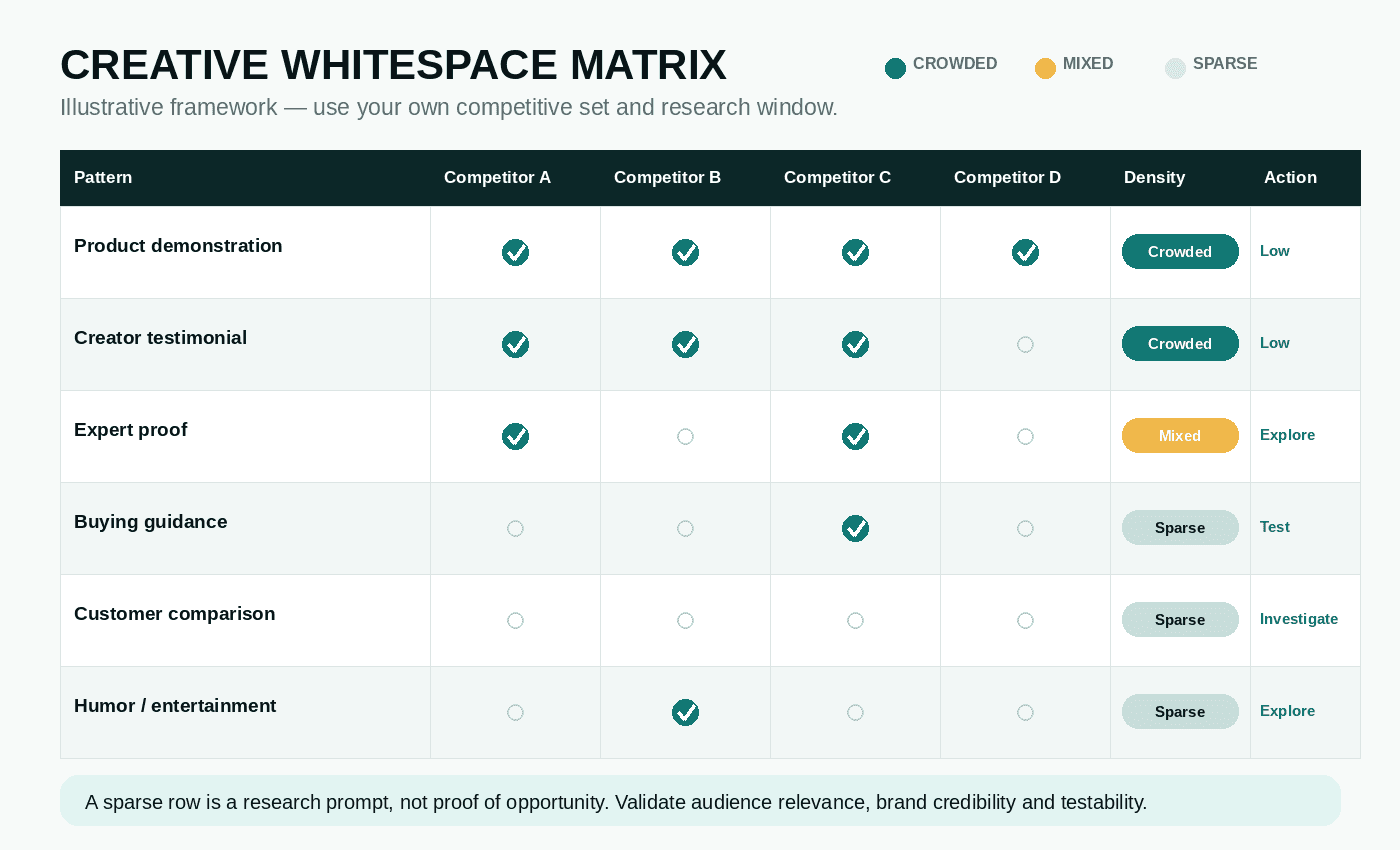
Start by asking what the category does too consistently. You may notice that nearly every ad opens with a product demonstration, most messaging leads with the same functional benefit, creators are used mainly for testimonials, or premium brands keep returning to the same visual language.
This is useful because whitespace only becomes visible against a picture of what is already crowded. Do not treat one unusual ad as evidence of a pattern. Look for repetition across multiple ads, multiple competitors and more than one point in time.
The same principle works in reverse. If something appears once, its rarity may be interesting, but you still need to determine whether it is an overlooked opportunity, a failed experiment or a choice that does not fit the category.
A gap is not automatically whitespace
A gap is not automatically whitespace
This is where competitor analysis often goes wrong. A strategist notices that nobody is doing something and decides the brand should own it. There may be a perfectly good reason nobody is doing it.
Imagine five premium skincare brands rarely use slapstick comedy. That is an absence. It becomes interesting only after you ask whether humor could address a real customer tension without damaging the trust, expertise or premium cues the brand relies on.
A useful whitespace opportunity usually passes four checks:
The audience has a reason to care
The gap connects to a real question, frustration, aspiration, objection or use case.
The brand can credibly occupy it
The idea makes sense coming from this brand rather than relying on competitor absence alone.
The territory is meaningfully underused
The whole research window supports the observation; it is not based on a few screenshots.
You can turn it into an observable test
The idea can become a hook, message, proof structure, format or concept that a creative team can make and evaluate.
This is where competitor analysis often goes wrong. A strategist notices that nobody is doing something and decides the brand should own it. There may be a perfectly good reason nobody is doing it.
Imagine five premium skincare brands rarely use slapstick comedy. That is an absence. It becomes interesting only after you ask whether humor could address a real customer tension without damaging the trust, expertise or premium cues the brand relies on.
A useful whitespace opportunity usually passes four checks:
The audience has a reason to care
The gap connects to a real question, frustration, aspiration, objection or use case.
The brand can credibly occupy it
The idea makes sense coming from this brand rather than relying on competitor absence alone.
The territory is meaningfully underused
The whole research window supports the observation; it is not based on a few screenshots.
You can turn it into an observable test
The idea can become a hook, message, proof structure, format or concept that a creative team can make and evaluate.
Look for whitespace across more than one dimension
Look for whitespace across more than one dimension
“Competitors are not talking about sustainability” is one possible gap. There are several other places to look.
Message whitespace
Which customer benefit, concern, use case or point of view receives little attention?
Proof whitespace
Everyone may promise the same result but rely on the same evidence. Could the brand prove the claim differently through expert explanation, process, demonstration, customer evidence, comparison or product construction?
Format whitespace
The message may be crowded while the delivery method is not. A category dominated by polished product films may leave room for creator demonstrations, founder explanations, customer routines, lo-fi testing or visual comparisons.
Audience whitespace
Competitors may repeatedly address the obvious buyer while giving less attention to another credible use case or customer situation.
Emotional whitespace
A category can become emotionally repetitive. Everyone reassures, inspires or tries to look aspirational. A brand may have room to be more practical, curious, playful, direct or educational if that tone fits the audience and the brand.
“Competitors are not talking about sustainability” is one possible gap. There are several other places to look.
Message whitespace
Which customer benefit, concern, use case or point of view receives little attention?
Proof whitespace
Everyone may promise the same result but rely on the same evidence. Could the brand prove the claim differently through expert explanation, process, demonstration, customer evidence, comparison or product construction?
Format whitespace
The message may be crowded while the delivery method is not. A category dominated by polished product films may leave room for creator demonstrations, founder explanations, customer routines, lo-fi testing or visual comparisons.
Audience whitespace
Competitors may repeatedly address the obvious buyer while giving less attention to another credible use case or customer situation.
Emotional whitespace
A category can become emotionally repetitive. Everyone reassures, inspires or tries to look aspirational. A brand may have room to be more practical, curious, playful, direct or educational if that tone fits the audience and the brand.
Separate useful differentiation from novelty
Separate useful differentiation from novelty
The goal is not to make work that looks different in a competitive review and nowhere else. A useful difference should improve the brief.
Suppose your analysis shows that every competitor leads with product features while customer conversations repeatedly focus on the difficulty of choosing the right option. The opportunity may be to build creative around helping the customer choose, not merely to change the visual style.
That could produce several executions:
a “which one is right for you?” creator video
a side-by-side comparison guide
a decision-tree concept
an expert recommendation
a product-selection quiz
creative built around common buying mistakes
One observed gap has now become several creative hypotheses. That is more useful than adding “Be more educational” to the brief.
The goal is not to make work that looks different in a competitive review and nowhere else. A useful difference should improve the brief.
Suppose your analysis shows that every competitor leads with product features while customer conversations repeatedly focus on the difficulty of choosing the right option. The opportunity may be to build creative around helping the customer choose, not merely to change the visual style.
That could produce several executions:
a “which one is right for you?” creator video
a side-by-side comparison guide
a decision-tree concept
an expert recommendation
a product-selection quiz
creative built around common buying mistakes
One observed gap has now become several creative hypotheses. That is more useful than adding “Be more educational” to the brief.
Turn whitespace into a test, not a positioning claim
Turn whitespace into a test, not a positioning claim
Competitor research can tell you what appears crowded or underrepresented in the observed set. It cannot prove that an open territory will perform. Treat whitespace as a hypothesis and keep the observation separate from the recommendation.

A simple creative test should define:
What we observed: Competitors consistently use X.
What appears underrepresented: Y receives little attention in the current competitive set.
Why it may matter: The audience has a relevant problem, question or motivation that Y addresses.
What we will make: Two or three executions that express the idea consistently enough to compare.
What we will measure: The metric appropriate to the job of the creative.
Competitor research can tell you what appears crowded or underrepresented in the observed set. It cannot prove that an open territory will perform. Treat whitespace as a hypothesis and keep the observation separate from the recommendation.
A simple creative test should define:
What we observed: Competitors consistently use X.
What appears underrepresented: Y receives little attention in the current competitive set.
Why it may matter: The audience has a relevant problem, question or motivation that Y addresses.
What we will make: Two or three executions that express the idea consistently enough to compare.
What we will measure: The metric appropriate to the job of the creative.
You can start with a spreadsheet
You can start with a spreadsheet
You do not need specialist software to start. Create one row per ad and record the fields you need for the brief:
brand
date
platform
hook
main message
proof
format
audience
creator role
offer
link or screenshot
After 30 or 40 ads, sort the sheet. Patterns that were difficult to see in a folder often become easier to discuss when similar choices sit next to one another. The manual version becomes harder when the competitive set grows, the research needs frequent refreshes or the team needs to compare several dimensions at once.
You do not need specialist software to start. Create one row per ad and record the fields you need for the brief:
brand
date
platform
hook
main message
proof
format
audience
creator role
offer
link or screenshot
After 30 or 40 ads, sort the sheet. Patterns that were difficult to see in a folder often become easier to discuss when similar choices sit next to one another. The manual version becomes harder when the competitive set grows, the research needs frequent refreshes or the team needs to compare several dimensions at once.
Where Adology can help with the whitespace read
Where Adology can help with the whitespace read
If your team uses Adology, this is a practical job for a defined Knowledge Set. Scope the research around a focal brand and relevant competitors, then compare positioning, creative patterns, competitive tone and areas that appear underused.
Adology’s current Brand Marketing Mode is built for this kind of category read. It returns positioning, whitespace, competitive tone and content direction grounded in what is running across the selected set.
The product does not remove the strategic decision. The useful part is getting from a pile of ads to a structured set of patterns and examples faster, with the underlying creative available for review. You still need to decide whether the gap matters to the audience, whether your brand can credibly use it and what deserves to be tested.
If your team uses Adology, this is a practical job for a defined Knowledge Set. Scope the research around a focal brand and relevant competitors, then compare positioning, creative patterns, competitive tone and areas that appear underused.
Adology’s current Brand Marketing Mode is built for this kind of category read. It returns positioning, whitespace, competitive tone and content direction grounded in what is running across the selected set.
The product does not remove the strategic decision. The useful part is getting from a pile of ads to a structured set of patterns and examples faster, with the underlying creative available for review. You still need to decide whether the gap matters to the audience, whether your brand can credibly use it and what deserves to be tested.
Put the reasoning in the brief
Put the reasoning in the brief
Do not hand the creative team a slide that says “Whitespace: Education.” Give them the reasoning.
OBSERVED PATTERN Four direct competitors lead primarily with product claims and lifestyle imagery. Buying guidance appears infrequently in the reviewed set. |
|---|
OPPORTUNITY TO TEST Creative that helps first-time buyers understand how to choose between product types. |
CREATIVE DIRECTION Test creator-led selection advice, side-by-side comparisons and a “choose based on your situation” format. |
WHAT WE DO NOT KNOW YET Whether education improves response relative to the current product-led creative. |
Now the research can survive the handoff from strategy to creative. The team knows what was observed, what is interpretation and what still needs proof.
Do not hand the creative team a slide that says “Whitespace: Education.” Give them the reasoning.
OBSERVED PATTERN Four direct competitors lead primarily with product claims and lifestyle imagery. Buying guidance appears infrequently in the reviewed set. |
|---|
OPPORTUNITY TO TEST Creative that helps first-time buyers understand how to choose between product types. |
CREATIVE DIRECTION Test creator-led selection advice, side-by-side comparisons and a “choose based on your situation” format. |
WHAT WE DO NOT KNOW YET Whether education improves response relative to the current product-led creative. |
Now the research can survive the handoff from strategy to creative. The team knows what was observed, what is interpretation and what still needs proof.
Use whitespace research to improve the next question
Use whitespace research to improve the next question
Competitive research is easy to confuse with inspiration gathering. Inspiration asks what you could make. Whitespace research asks what the category repeatedly chooses, what relevant territory receives less attention and which of those gaps deserves a real test.
That question gives a strategist something useful to carry into the next brief even if no individual competitor ad is worth copying.
Try the method on your category. Build a Knowledge Set around your brand and the competitors that matter, then compare positioning, creative patterns and underused territory behind the next brief. Explore Brand Marketing Mode
Competitive research is easy to confuse with inspiration gathering. Inspiration asks what you could make. Whitespace research asks what the category repeatedly chooses, what relevant territory receives less attention and which of those gaps deserves a real test.
That question gives a strategist something useful to carry into the next brief even if no individual competitor ad is worth copying.
Try the method on your category. Build a Knowledge Set around your brand and the competitors that matter, then compare positioning, creative patterns and underused territory behind the next brief. Explore Brand Marketing Mode

How to Analyze What Social Listening Misses in Video Posts
How to Analyze What Social Listening Misses in Video Posts

How to Build a Competitive Creative Briefing Executives Will Actually Use
How to Build a Competitive Creative Briefing Executives Will Actually Use

Your Swipe File Is Dysfunctional. Let’s Fix It
Your Swipe File Is Dysfunctional. Let’s Fix It

Why Better Prompts Don’t Fix Generic Marketing Advice
Why Better Prompts Don’t Fix Generic Marketing Advice

How to Benchmark Competitor Creative Against Client Goals
How to Benchmark Competitor Creative Against Client Goals

What Are Hydration Brands Actually Selling?
What Are Hydration Brands Actually Selling?

Is It a Creative Pattern or a Standout Ad?
Is It a Creative Pattern or a Standout Ad?

How to Analyze Competitor Ads With an AI Assistant
How to Analyze Competitor Ads With an AI Assistant
Best Ad Intelligence Tools in 2026: An Honest Breakdown
Best Ad Intelligence Tools in 2026: An Honest Breakdown

How to Analyze Competitor Ads (Without the Screenshot Grind)
How to Analyze Competitor Ads (Without the Screenshot Grind)
The market
The market
is moving right now.
is moving right now.
Your competitors' intelligence is updating. Your next brief will either start from what's actually working in your category this week, or it won't.
Your competitors' intelligence is updating. Your next brief will either start from what's actually working in your category this week, or it won't.
Free signup
Free signup
Pay as you go
Pay as you go
Cancel whenever
Cancel whenever
ADOLOGY AI
ADOLOGY AI
Marketing intelligence that holds itself accountable. Watches your market continuously, ships intelligence into your workflows, grades itself on every call.
Marketing intelligence that holds itself accountable. Watches your market continuously, ships intelligence into your workflows, grades itself on every call.
ADOLOGY
© 2026 Adology. All rights reserved.
© 2026 Adology. All rights reserved.