Back
Back
How to Build a Competitive Creative Briefing Executives Will Actually Use
How to Build a Competitive Creative Briefing Executives Will Actually Use

Before the strategist opens another tab, they should write down the decisions this briefing may affect. A value-focused home brand has three choices. It can change its next promotion or test a creator-led product demo. It can also watch a competitor’s new message for another week.
The strategist can now test each finding against those decisions. The competitor’s promotion may affect an offer already in development. The repeated creator format may suggest a test worth planning. A single popular post may be interesting, but it may not support any action yet.
The decision list also keeps the briefing short. Some findings will not change a planned decision, a creative test, or the team’s watchlist. Those findings can stay in the working notes.
Before the strategist opens another tab, they should write down the decisions this briefing may affect. A value-focused home brand has three choices. It can change its next promotion or test a creator-led product demo. It can also watch a competitor’s new message for another week.
The strategist can now test each finding against those decisions. The competitor’s promotion may affect an offer already in development. The repeated creator format may suggest a test worth planning. A single popular post may be interesting, but it may not support any action yet.
The decision list also keeps the briefing short. Some findings will not change a planned decision, a creative test, or the team’s watchlist. Those findings can stay in the working notes.
Decide what counts as a change
Decide what counts as a change
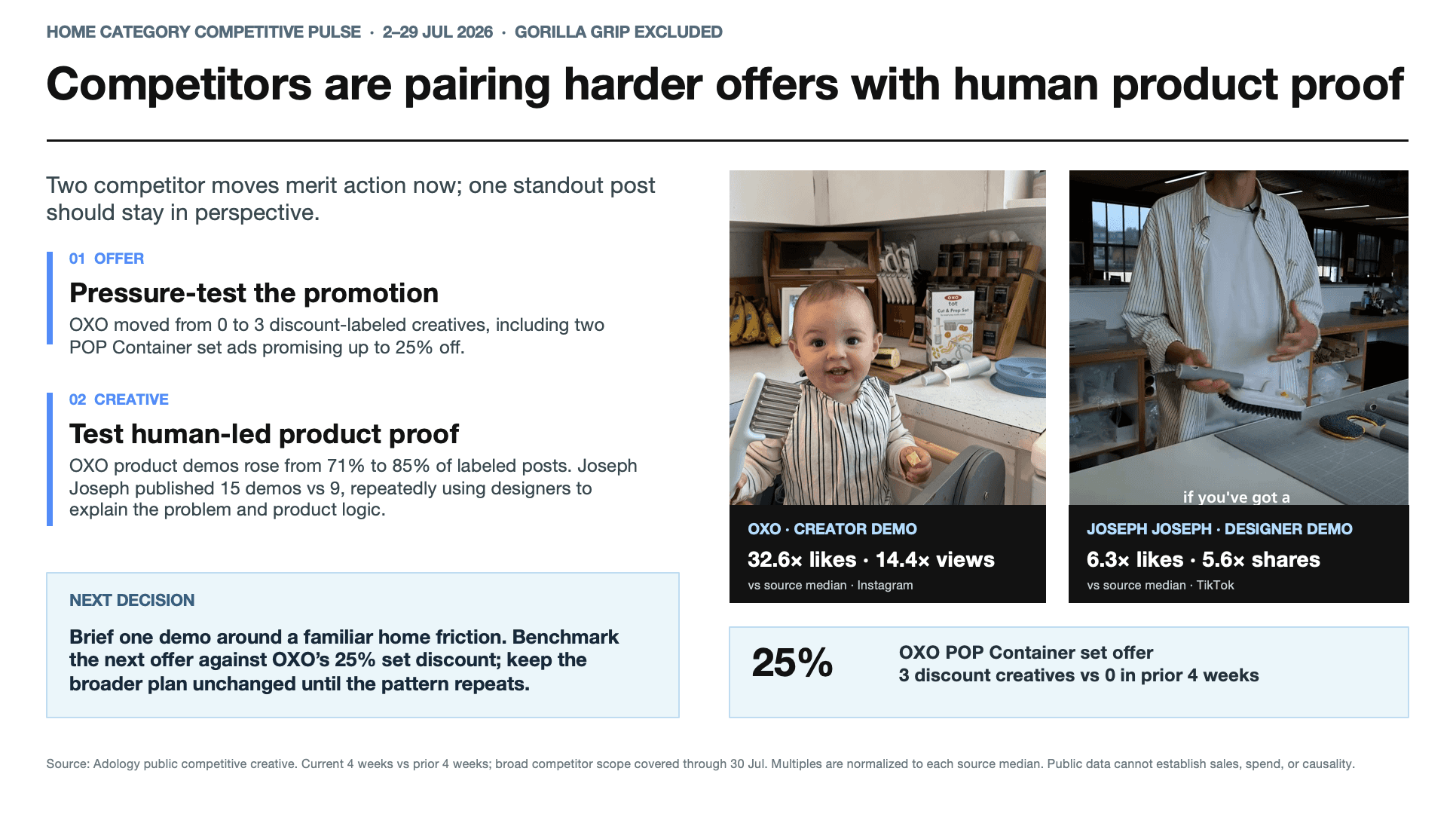
Teams often compare this week’s posts with their memory of last week. Memory is quick, but it can make a familiar campaign look new. It can also hide a slow shift that took several weeks.
Use a fixed comparison period and look for four types of change:
New: A competitor launches an offer, message, format, product, or audience angle that was absent from the prior period.
Stopped: A recurring offer or format disappears during the chosen period.
Scaled: A brand uses an offer, message, or format more often, on more channels, or in more versions.
Repeated: A brand returns to a format or message often enough for the team to study it as a possible test.
“Scaled” needs special care. Public posts can show that a brand made more versions or posted more often. They do not reveal the brand’s full media budget or prove that the campaign drove sales.
In our Monday example, the new promotion may affect the client’s next offer. That link earns the promotion a place in the working brief. The creator format also deserves a note because the competitor used it three times during the chosen period. Before adding the popular post, the strategist needs the account’s normal engagement range. They also need to check whether the post was boosted.
Teams often compare this week’s posts with their memory of last week. Memory is quick, but it can make a familiar campaign look new. It can also hide a slow shift that took several weeks.
Use a fixed comparison period and look for four types of change:
New: A competitor launches an offer, message, format, product, or audience angle that was absent from the prior period.
Stopped: A recurring offer or format disappears during the chosen period.
Scaled: A brand uses an offer, message, or format more often, on more channels, or in more versions.
Repeated: A brand returns to a format or message often enough for the team to study it as a possible test.
“Scaled” needs special care. Public posts can show that a brand made more versions or posted more often. They do not reveal the brand’s full media budget or prove that the campaign drove sales.
In our Monday example, the new promotion may affect the client’s next offer. That link earns the promotion a place in the working brief. The creator format also deserves a note because the competitor used it three times during the chosen period. Before adding the popular post, the strategist needs the account’s normal engagement range. They also need to check whether the post was boosted.
Put the source beside the claim
Put the source beside the claim
An executive should be able to inspect the creative without asking the team to hunt through a folder. Place the link or image beside the sentence it supports. Then add the date, platform, format, and comparison period.
For the high-engagement post, the strategist should also check the brand’s normal range. Ten thousand likes sounds large until you learn that the account often gets twelve thousand. The same count would look unusual on an account that normally gets five hundred.
Check every paid or organic label against the source. If the source does not confirm whether a post was boosted, label the status as unknown or inferred.
Give each finding a short evidence block:
the post, ad, or landing page.
the date and platform.
what changed against the chosen period.
the useful baseline, such as the brand’s usual posting rate or engagement range.
any missing data that could change the reading.
An executive should be able to inspect the creative without asking the team to hunt through a folder. Place the link or image beside the sentence it supports. Then add the date, platform, format, and comparison period.
For the high-engagement post, the strategist should also check the brand’s normal range. Ten thousand likes sounds large until you learn that the account often gets twelve thousand. The same count would look unusual on an account that normally gets five hundred.
Check every paid or organic label against the source. If the source does not confirm whether a post was boosted, label the status as unknown or inferred.
Give each finding a short evidence block:
the post, ad, or landing page.
the date and platform.
what changed against the chosen period.
the useful baseline, such as the brand’s usual posting rate or engagement range.
any missing data that could change the reading.
Separate what you saw from what you think
Separate what you saw from what you think
Most weak briefings blur the observation and the recommendation into one sentence. “Competitor A is winning with creators” may sound firm, but the team cannot inspect “winning.” The sentence also jumps from visible content to a business result. Public data cannot prove that result.
Write each finding in three parts instead:
Observation: Competitor A published three creator-led product demos in four weeks, compared with none in the prior four weeks.
Interpretation: The repeated format suggests the brand is giving creator-led demonstrations more room in its current content mix.
Next move: Review the three openings and product moments, then decide whether one fits the home brand’s next creative test.
A client may accept the observation but reject the suggested test. The team can then debate the decision without arguing over what the competitor posted.
Most weak briefings blur the observation and the recommendation into one sentence. “Competitor A is winning with creators” may sound firm, but the team cannot inspect “winning.” The sentence also jumps from visible content to a business result. Public data cannot prove that result.
Write each finding in three parts instead:
Observation: Competitor A published three creator-led product demos in four weeks, compared with none in the prior four weeks.
Interpretation: The repeated format suggests the brand is giving creator-led demonstrations more room in its current content mix.
Next move: Review the three openings and product moments, then decide whether one fits the home brand’s next creative test.
A client may accept the observation but reject the suggested test. The team can then debate the decision without arguing over what the competitor posted.
Keep the limit in the briefing
Keep the limit in the briefing
Public creative data shows what a brand made visible. It can help a team track messages, offers, formats, posting patterns, and public response. It usually cannot show sales, conversion, brand lift, private media spend, or the competitor’s full plan.
Put the limit near the finding it affects. Don’t bury one broad disclaimer at the end of the deck. If the large organic post may have received paid support, say that beside the engagement number. If the team cannot see spending, describe a rise in creative versions rather than a rise in budget.
The notes show what the team saw and what it inferred. They also name the question that still needs an answer.
Public creative data shows what a brand made visible. It can help a team track messages, offers, formats, posting patterns, and public response. It usually cannot show sales, conversion, brand lift, private media spend, or the competitor’s full plan.
Put the limit near the finding it affects. Don’t bury one broad disclaimer at the end of the deck. If the large organic post may have received paid support, say that beside the engagement number. If the team cannot see spending, describe a rise in creative versions rather than a rise in budget.
The notes show what the team saw and what it inferred. They also name the question that still needs an answer.
Use a one-page briefing structure
Use a one-page briefing structure
The final briefing does not need to reproduce the research folder. A one-page version can contain:
The week in one sentence. Name the most relevant market change for the client’s current work.
Up to three changes. Include only the launches, stops, repeated formats, or visible increases that may affect a decision.
The proof. Show the creative, date, platform, comparison, and baseline.
The reading and its limit. Explain what the evidence may suggest and what it cannot establish.
The next decision. Name what the team should change, test, reject, or continue to watch.
The research appendix can hold the rest. Executives get the short version, while the strategist keeps the sources needed for questions.
The final briefing does not need to reproduce the research folder. A one-page version can contain:
The week in one sentence. Name the most relevant market change for the client’s current work.
Up to three changes. Include only the launches, stops, repeated formats, or visible increases that may affect a decision.
The proof. Show the creative, date, platform, comparison, and baseline.
The reading and its limit. Explain what the evidence may suggest and what it cannot establish.
The next decision. Name what the team should change, test, reject, or continue to watch.
The research appendix can hold the rest. Executives get the short version, while the strategist keeps the sources needed for questions.
Where Adology fits into the weekly work
Where Adology fits into the weekly work
If your team uses Adology, it can create the first draft of this weekly brief. Select the relevant brand portfolio and choose the competitive workflow. In about five minutes, you get a branded brief that is ready to review and share.
The strategist then checks the work. For the home-brand briefing, they should open the creative behind each finding and check the comparison period. They should also confirm which labels are known or inferred. Last, they should decide whether the proposed action fits the client’s current plans.
During that review, the strategist removes findings that do not affect the client. They also trim claims that go beyond the source. Then they place the change tied to the most urgent client decision at the top.
If your team uses Adology, it can create the first draft of this weekly brief. Select the relevant brand portfolio and choose the competitive workflow. In about five minutes, you get a branded brief that is ready to review and share.
The strategist then checks the work. For the home-brand briefing, they should open the creative behind each finding and check the comparison period. They should also confirm which labels are known or inferred. Last, they should decide whether the proposed action fits the client’s current plans.
During that review, the strategist removes findings that do not affect the client. They also trim claims that go beyond the source. Then they place the change tied to the most urgent client decision at the top.
Give each finding a job
Give each finding a job
Before sending the briefing, read each finding once more. Ask what the client could do differently because that finding is there.
The client might revise an offer or test a format. The team might also inspect the competitor for another week or make no change. “Make no change” is a valid recommendation when the evidence shows one noisy post rather than a repeated move.
If the finding cannot affect a decision, test, or monitoring priority, move it to the appendix. The meeting can then discuss the next offer, creative test, or competitor check. No one needs to sort screenshots in the room.
Before sending the briefing, read each finding once more. Ask what the client could do differently because that finding is there.
The client might revise an offer or test a format. The team might also inspect the competitor for another week or make no change. “Make no change” is a valid recommendation when the evidence shows one noisy post rather than a repeated move.
If the finding cannot affect a decision, test, or monitoring priority, move it to the appendix. The meeting can then discuss the next offer, creative test, or competitor check. No one needs to sort screenshots in the room.

How to Analyze What Social Listening Misses in Video Posts
How to Analyze What Social Listening Misses in Video Posts

Your Swipe File Is Dysfunctional. Let’s Fix It
Your Swipe File Is Dysfunctional. Let’s Fix It

Why Better Prompts Don’t Fix Generic Marketing Advice
Why Better Prompts Don’t Fix Generic Marketing Advice

How to Benchmark Competitor Creative Against Client Goals
How to Benchmark Competitor Creative Against Client Goals

What Are Hydration Brands Actually Selling?
What Are Hydration Brands Actually Selling?

Is It a Creative Pattern or a Standout Ad?
Is It a Creative Pattern or a Standout Ad?

How to Find Creative Whitespace in Competitor Ads
How to Find Creative Whitespace in Competitor Ads

How to Analyze Competitor Ads With an AI Assistant
How to Analyze Competitor Ads With an AI Assistant
Best Ad Intelligence Tools in 2026: An Honest Breakdown
Best Ad Intelligence Tools in 2026: An Honest Breakdown

How to Analyze Competitor Ads (Without the Screenshot Grind)
How to Analyze Competitor Ads (Without the Screenshot Grind)
The market
The market
is moving right now.
is moving right now.
Your competitors' intelligence is updating. Your next brief will either start from what's actually working in your category this week, or it won't.
Your competitors' intelligence is updating. Your next brief will either start from what's actually working in your category this week, or it won't.
Free signup
Free signup
Pay as you go
Pay as you go
Cancel whenever
Cancel whenever
ADOLOGY AI
ADOLOGY AI
Marketing intelligence that holds itself accountable. Watches your market continuously, ships intelligence into your workflows, grades itself on every call.
Marketing intelligence that holds itself accountable. Watches your market continuously, ships intelligence into your workflows, grades itself on every call.
ADOLOGY
© 2026 Adology. All rights reserved.
© 2026 Adology. All rights reserved.