Back
Back
Your Swipe File Is Dysfunctional. Let’s Fix It
Your Swipe File Is Dysfunctional. Let’s Fix It

A swipe file only helps if the team remembers what it saw in the work. Here is a simple way to keep the observation attached to the reference.
Open a typical agency swipe file, and you will find a little creative archaeology: a Nike film saved for “tone,” a restaurant TikTok saved because it was funny, a founder video somebody called “authentic,” and six carousels labeled “great hook.”
It looks like evidence of good taste, but then a live brief arrives.
Someone shares the folder. The team scrolls. Nobody remembers what made half the references useful, or what a perfume film and a fast-food TikTok are supposed to contribute to the same piece of work.
There is nothing wrong with collecting examples. The trouble starts when the reason for saving them disappears.
A swipe file only helps if the team remembers what it saw in the work. Here is a simple way to keep the observation attached to the reference.
Open a typical agency swipe file, and you will find a little creative archaeology: a Nike film saved for “tone,” a restaurant TikTok saved because it was funny, a founder video somebody called “authentic,” and six carousels labeled “great hook.”
It looks like evidence of good taste, but then a live brief arrives.
Someone shares the folder. The team scrolls. Nobody remembers what made half the references useful, or what a perfume film and a fast-food TikTok are supposed to contribute to the same piece of work.
There is nothing wrong with collecting examples. The trouble starts when the reason for saving them disappears.
What gets lost when you save example content
What gets lost when you save example content
Most swipe files are organized around what the work is: beauty ads, founder videos, UGC, carousels, nice lighting.
A brief needs to know what the work did.
Did the ad turn an invisible benefit into something you could see?
Did it make a product demonstration entertaining enough to finish?
Did the creator answer the objection before the audience had time to raise it?
Did the brand use a familiar format in a way that felt unmistakably its own?
Those observations rarely survive the save. Months later, the next team sees the surface, the camera angle, caption style, or casting choice and copies that instead.
Most swipe files are organized around what the work is: beauty ads, founder videos, UGC, carousels, nice lighting.
A brief needs to know what the work did.
Did the ad turn an invisible benefit into something you could see?
Did it make a product demonstration entertaining enough to finish?
Did the creator answer the objection before the audience had time to raise it?
Did the brand use a familiar format in a way that felt unmistakably its own?
Those observations rarely survive the save. Months later, the next team sees the surface, the camera angle, caption style, or casting choice and copies that instead.
Add four notes to every swipe file reference
Add four notes to every swipe file reference
You do not need a complicated taxonomy. Add four short notes when a reference earns a place in the folder:
What caught our attention? Name the exact moment, line or choice.
What job did it do? Demonstrate, reassure, explain, invite, provoke or entertain.
Why did it fit this brand? Look for a product truth, audience habit, distinctive asset or cultural permission.
What might be useful elsewhere? Describe the underlying mechanism without prescribing the same execution.
Take a mock documentary that makes a dry product feature watchable. “Make a mock documentary” is a production instruction. “Use a familiar entertainment format to earn attention for information people normally skip” is an idea a team can explore.
The second version gives the team room to find an execution that fits the brand and the brief.
You do not need a complicated taxonomy. Add four short notes when a reference earns a place in the folder:
What caught our attention? Name the exact moment, line or choice.
What job did it do? Demonstrate, reassure, explain, invite, provoke or entertain.
Why did it fit this brand? Look for a product truth, audience habit, distinctive asset or cultural permission.
What might be useful elsewhere? Describe the underlying mechanism without prescribing the same execution.
Take a mock documentary that makes a dry product feature watchable. “Make a mock documentary” is a production instruction. “Use a familiar entertainment format to earn attention for information people normally skip” is an idea a team can explore.
The second version gives the team room to find an execution that fits the brand and the brief.
Separate a good example from a category pattern
Separate a good example from a category pattern
One saved ad tells you that one brand made one choice. It does not tell you that the whole category is moving in that direction.
You have the beginning of a pattern when the choice appears across several brands, creators, or moments. Perhaps product education is moving into entertainment formats. Perhaps founders are becoming recurring characters. Perhaps comments are being used as ready-made scripts.
That pattern may be relevant to the next brief, or it may simply describe what everyone else is doing. The distinction matters. Sometimes the useful move is to study the pattern. Sometimes it is to avoid adding another version of it.
This is why a single bottomless inspiration board becomes difficult to use. It mixes isolated references, recurring market choices, and ideas that are genuinely relevant to current work.
One saved ad tells you that one brand made one choice. It does not tell you that the whole category is moving in that direction.
You have the beginning of a pattern when the choice appears across several brands, creators, or moments. Perhaps product education is moving into entertainment formats. Perhaps founders are becoming recurring characters. Perhaps comments are being used as ready-made scripts.
That pattern may be relevant to the next brief, or it may simply describe what everyone else is doing. The distinction matters. Sometimes the useful move is to study the pattern. Sometimes it is to avoid adding another version of it.
This is why a single bottomless inspiration board becomes difficult to use. It mixes isolated references, recurring market choices, and ideas that are genuinely relevant to current work.
Search the library with a live question
Search the library with a live question
If your team uses Adology, this is a handy job for the Library.
Scout, Adology’s AI research agent, has already collected the ads and organic posts from the brands, competitors, creators, and other sources you track. Instead of opening six platforms and trying to remember where you saw something, start with the question in the brief.
The Library searches by meaning, so the post does not need to contain your exact words. You can then narrow the results by brand, platform, format, date, and other filters.
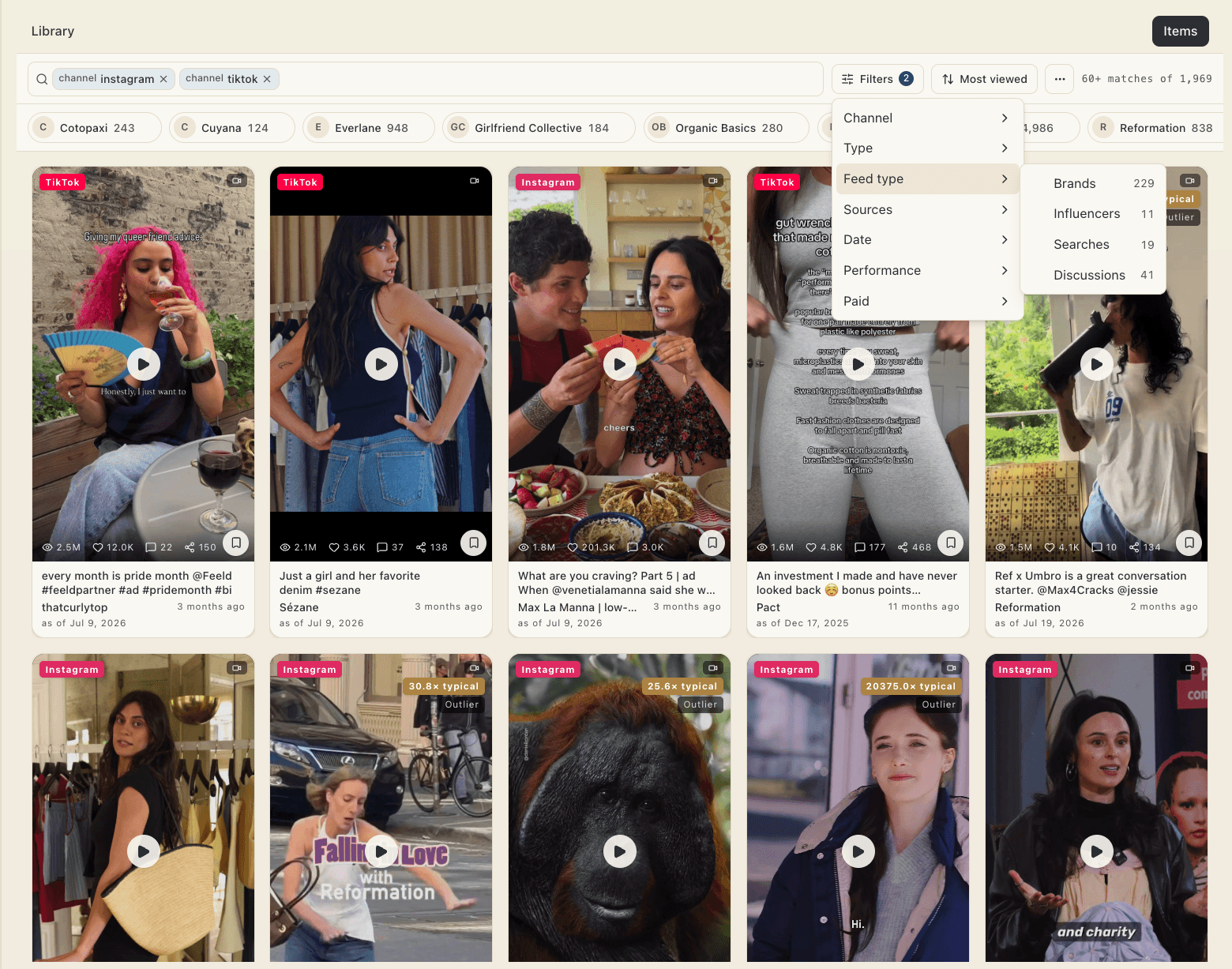
“Show me great skincare ads” will produce another browsing session. “Show me how skincare brands demonstrate benefits that are difficult to see” gives the search a job. From there, the team can compare the mechanisms, add the four notes and save the useful examples into a collection named after the problem in the brief.
Collections can be organized around a campaign, competitor, trend, or format. For a live brief, name the Collection after the thing the team is trying to figure out:
How are brands making an invisible benefit visible?
How are creators introducing a product without stopping the story?
How are competitors answering price objections?
What does everyone in the category do in the first three seconds?
Save the shortlist there. “How skincare brands make invisible benefits visible” will still make sense when somebody opens it next month. “Skincare inspo” is where the context goes to die.
If your team uses Adology, this is a handy job for the Library.
Scout, Adology’s AI research agent, has already collected the ads and organic posts from the brands, competitors, creators, and other sources you track. Instead of opening six platforms and trying to remember where you saw something, start with the question in the brief.
The Library searches by meaning, so the post does not need to contain your exact words. You can then narrow the results by brand, platform, format, date, and other filters.
“Show me great skincare ads” will produce another browsing session. “Show me how skincare brands demonstrate benefits that are difficult to see” gives the search a job. From there, the team can compare the mechanisms, add the four notes and save the useful examples into a collection named after the problem in the brief.
Collections can be organized around a campaign, competitor, trend, or format. For a live brief, name the Collection after the thing the team is trying to figure out:
How are brands making an invisible benefit visible?
How are creators introducing a product without stopping the story?
How are competitors answering price objections?
What does everyone in the category do in the first three seconds?
Save the shortlist there. “How skincare brands make invisible benefits visible” will still make sense when somebody opens it next month. “Skincare inspo” is where the context goes to die.
Try it on the next brief
Try it on the next brief
Leave the old swipe file alone. Cleaning years of saved work is a fine way to avoid the work due Friday.
Start with the next assignment:
Write the creative problem in one sentence.
Search for ten references that might help answer it.
Add the four notes to each reference.
Group the examples by what they do, rather than how they look.
Decide which two mechanisms deserve exploration and which category habit you want to avoid.
By the time creative development starts, the team should know why each reference is in the room. If someone asks, the answer should be better than, “I think somebody saved it last summer.”
Want to try this on your next brief? Explore Adology free with code EXPLORE2026
Leave the old swipe file alone. Cleaning years of saved work is a fine way to avoid the work due Friday.
Start with the next assignment:
Write the creative problem in one sentence.
Search for ten references that might help answer it.
Add the four notes to each reference.
Group the examples by what they do, rather than how they look.
Decide which two mechanisms deserve exploration and which category habit you want to avoid.
By the time creative development starts, the team should know why each reference is in the room. If someone asks, the answer should be better than, “I think somebody saved it last summer.”
Want to try this on your next brief? Explore Adology free with code EXPLORE2026
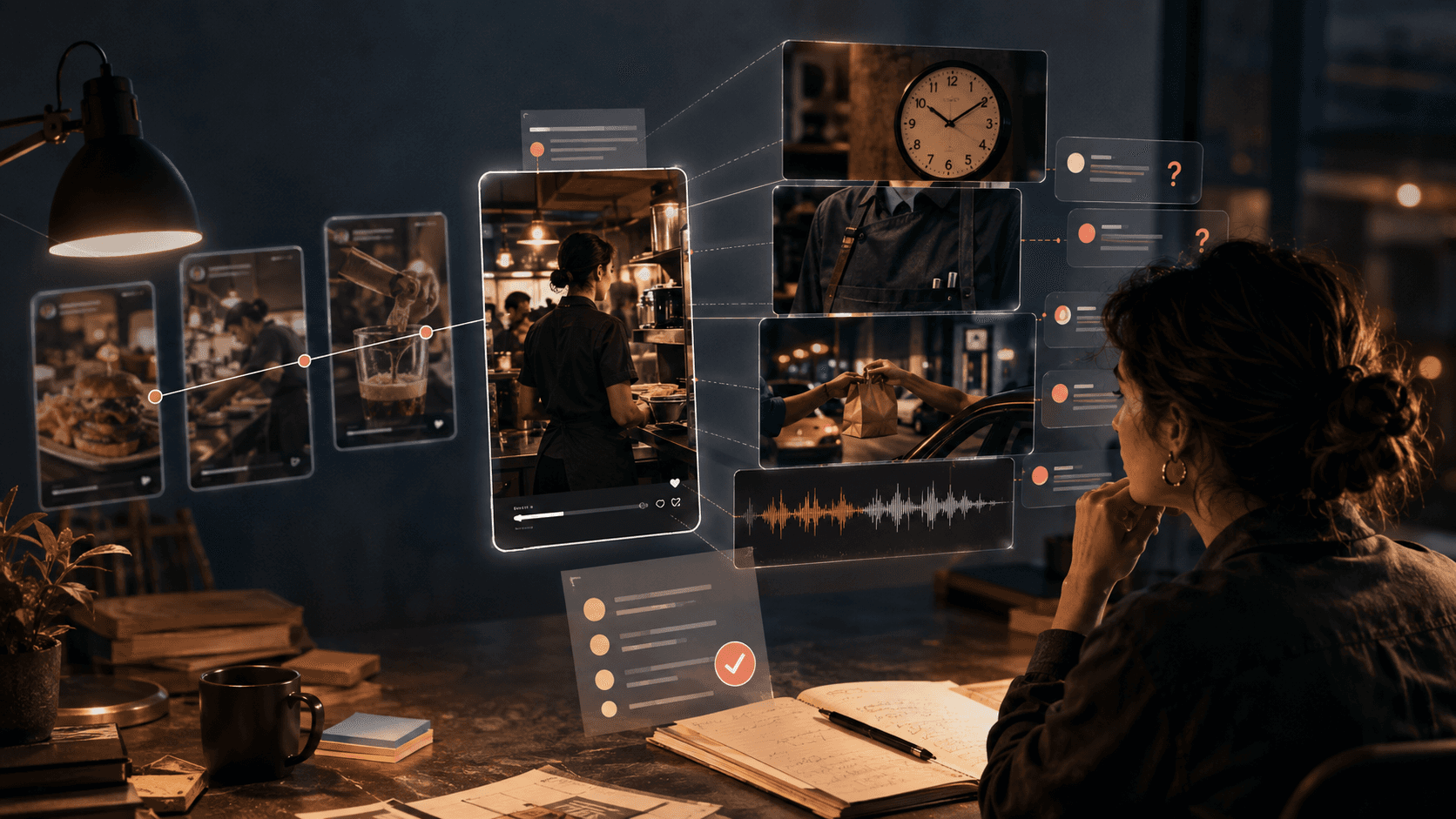
How to Analyze What Social Listening Misses in Video Posts
How to Analyze What Social Listening Misses in Video Posts

How to Build a Competitive Creative Briefing Executives Will Actually Use
How to Build a Competitive Creative Briefing Executives Will Actually Use

Why Better Prompts Don’t Fix Generic Marketing Advice
Why Better Prompts Don’t Fix Generic Marketing Advice

How to Benchmark Competitor Creative Against Client Goals
How to Benchmark Competitor Creative Against Client Goals

What Are Hydration Brands Actually Selling?
What Are Hydration Brands Actually Selling?

Is It a Creative Pattern or a Standout Ad?
Is It a Creative Pattern or a Standout Ad?

How to Find Creative Whitespace in Competitor Ads
How to Find Creative Whitespace in Competitor Ads

How to Analyze Competitor Ads With an AI Assistant
How to Analyze Competitor Ads With an AI Assistant
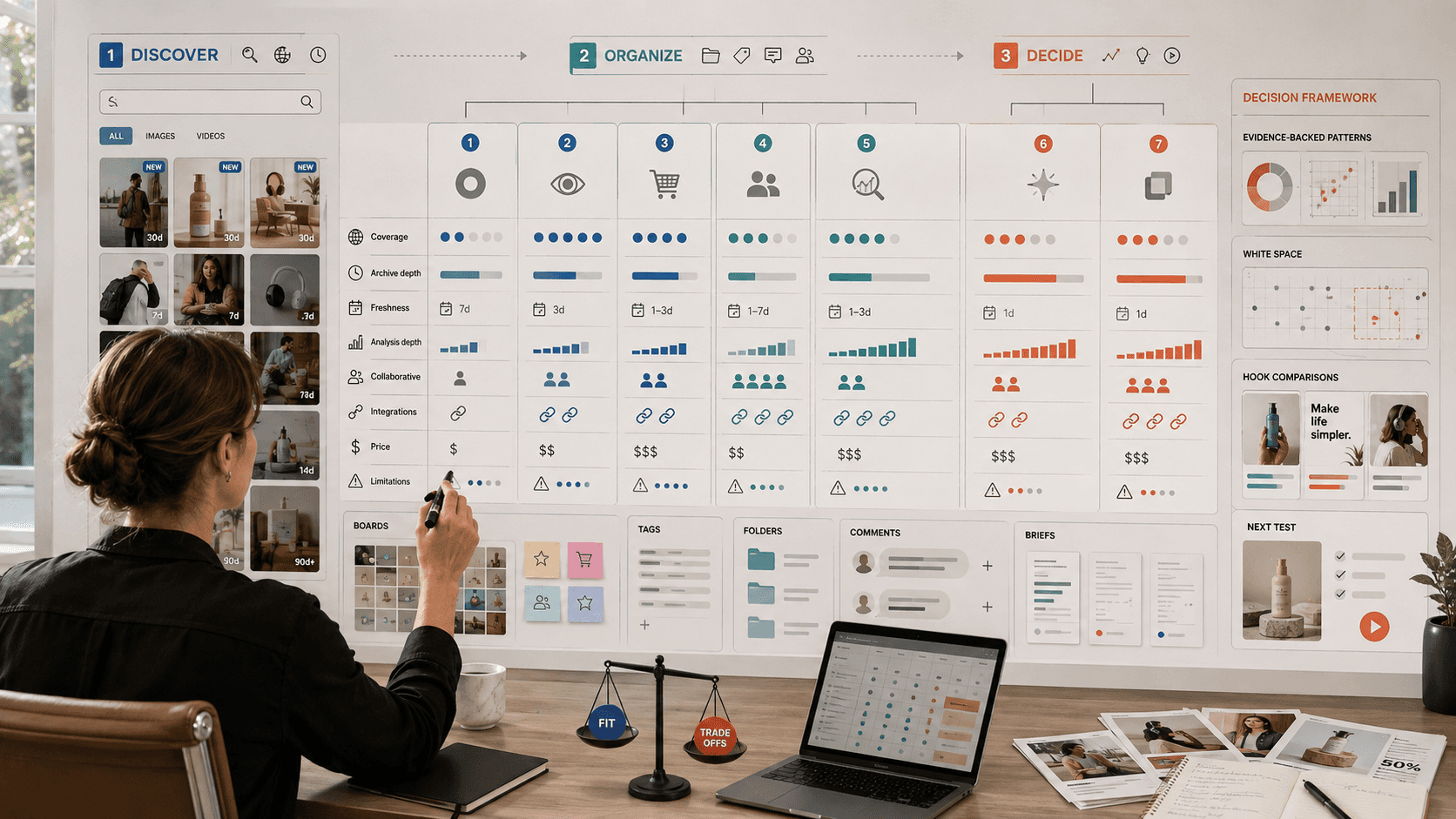
Best Ad Intelligence Tools in 2026: An Honest Breakdown
Best Ad Intelligence Tools in 2026: An Honest Breakdown

How to Analyze Competitor Ads (Without the Screenshot Grind)
How to Analyze Competitor Ads (Without the Screenshot Grind)
The market
The market
is moving right now.
is moving right now.
Your competitors' intelligence is updating. Your next brief will either start from what's actually working in your category this week, or it won't.
Your competitors' intelligence is updating. Your next brief will either start from what's actually working in your category this week, or it won't.
Free signup
Free signup
Pay as you go
Pay as you go
Cancel whenever
Cancel whenever
ADOLOGY AI
ADOLOGY AI
Marketing intelligence that holds itself accountable. Watches your market continuously, ships intelligence into your workflows, grades itself on every call.
Marketing intelligence that holds itself accountable. Watches your market continuously, ships intelligence into your workflows, grades itself on every call.
ADOLOGY
© 2026 Adology. All rights reserved.
© 2026 Adology. All rights reserved.